
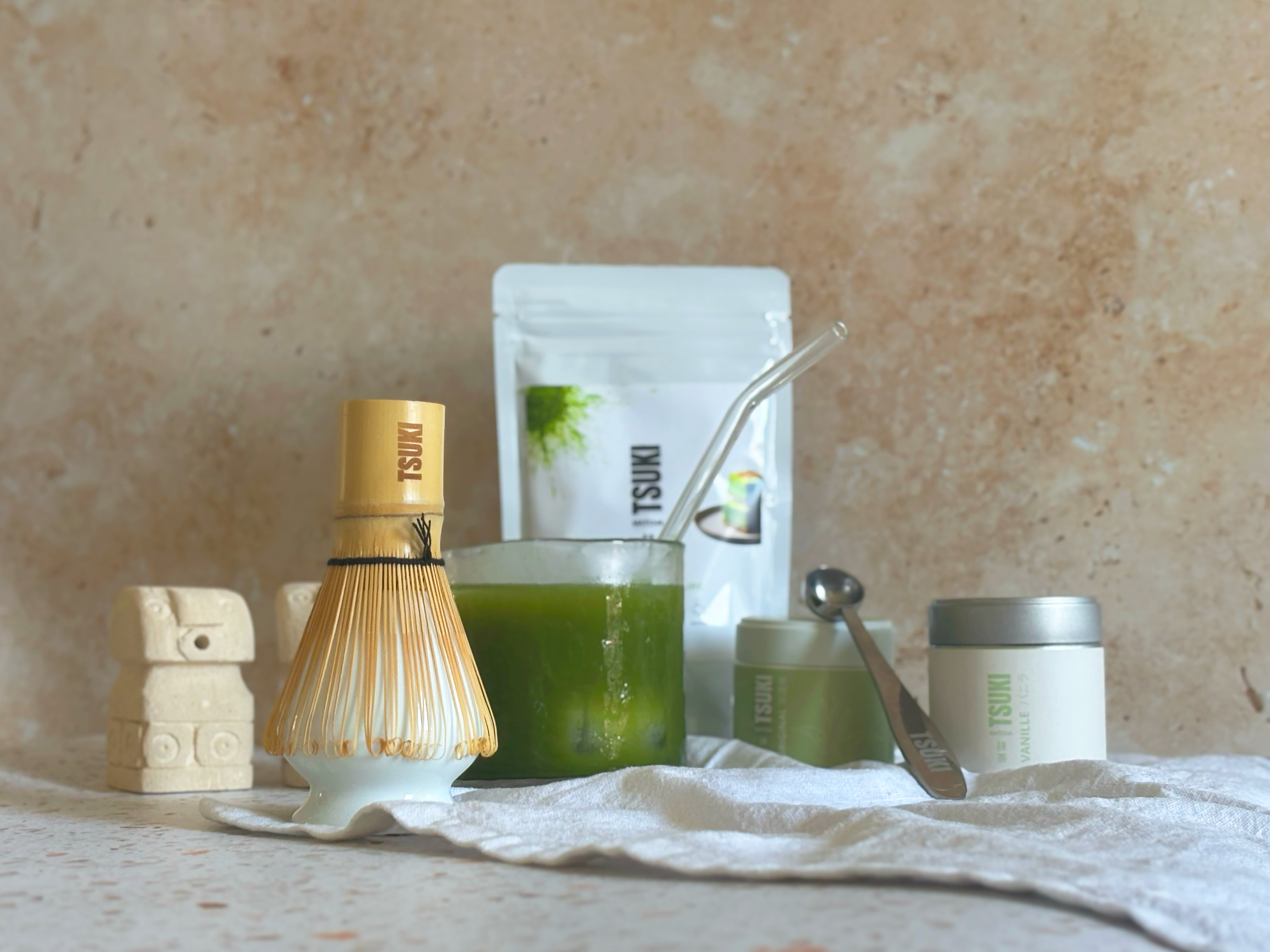

Matcha Serving Equipment for Cafes: A Comprehensive Guide to Professional Gear
Serving good matcha in a cafe doesn't require a large investment, but it does require the right equipment. Chasen or electric frother? Which sieve to avoid lumps in bulk? Which glasses for iced drinks? Here's the complete guide to professional matcha equipment, with real budgets and the trade-offs that really matter in service.

You want to add matcha to your menu, but one question keeps coming up: what equipment do you really need? On the internet, you can find anything and everything. Some will tell you that a simple bamboo whisk is enough, others will sell you stations for several thousand euros. The truth is simpler and more reassuring: equipping a cafe to serve quality matcha costs between 200 and 500 euros to start, and the investment pays for itself in a few weeks.
This article covers all professional matcha equipment, without excess or under-equipment. The truly essential equipment, the great debate between chasen and electric frother (with honest arguments from both sides), specific equipment for iced drinks, the real budget according to your volume, and equipment errors that undermine quality without you understanding why. Everything you need to equip your cafe intelligently, without spending an extra euro or skimping on what matters.
Essential equipment: chasen, sieve, bowl, measuring scoop
Let's start with the basics. Here are the four elements without which you cannot serve quality matcha in a cafe. None are negotiable, but none are expensive.
The bamboo whisk (chasen)
This is the emblematic tool for matcha preparation. Its thin bamboo prongs (between 80 and 120 depending on the model) allow the powder to dissolve and create the characteristic fine foam of matcha.

A quality bamboo whisk remains the reference tool for preparation quality, even if in high-volume service it will often be supplemented by an electric frother. Allow 15 to 30 euros per chasen, and plan for several in rotation so you are never stuck during cleaning.
The fine sieve
The most underestimated element, yet one of the most important in service. Matcha almost systematically forms lumps if it is not sifted. A fine sieve (Japanese tea sieve or small flour sieve type) allows 50 to 100 g of matcha to be pre-sifted at the start of service, stored in a separate airtight container. This eliminates lumps and saves precious time during rush hours. Allow 10 to 25 euros for a durable professional sieve. This is probably the best quality-impact ratio of all equipment.
The preparation bowl (chawan or working bowl)
To whisk the matcha with water before diluting it, you need a wide container that allows for the whisking motion.

In a cafe, two options: the traditional matcha bowl (chawan) for careful service, or a more practical stainless steel working bowl for volume. The important thing is the width: a container that is too narrow prevents proper whisking. Allow 15 to 40 euros depending on the type.
The measuring spoon (chashaku) or scale
To measure matcha regularly, there are two approaches. The bamboo measuring spoon (chashaku) for quick traditional dosing (a heaped spoonful is equivalent to about 1 g), or better for a cafe, a digital precision scale to 0.1 g.
The scale or the 1g measuring spoon guarantees perfect consistency between baristas and between preparations.

Allow 5 to 15 euros for a chashaku, 15 to 25 euros for a digital scale. For a cafe, the scale is highly recommended as it eliminates variations in dosage.
Table of essential equipment
| Item | Role | Budget |
|---|---|---|
| Bamboo whisk (chasen) ×2-3 | Dissolution + foam | €15-30 / unit |
| Fine sieve | Anti-lumping | €10-25 |
| Preparation bowl | Whisking | €15-40 |
| Digital scale 0.1 g | Consistent dosing | €15-25 |
| Temperature-controlled kettle | Water at 75 °C | €40-90 |
Traditional chasen vs. electric frother: the real cafe match
This is the debate that divides baristas. Should you stick to the traditional bamboo whisk or switch to an electric frother for service? The honest answer: both have their place, and the right choice depends on your volume. Here are the real arguments from each side.
The arguments for the traditional chasen
The bamboo whisk produces the best quality foam, fine and stable, the kind you expect from well-prepared matcha. It respects tradition, which matters for cafes with an authentic, matcha-centric positioning.
It doesn't need electricity or batteries, never breaks down, and its motion is part of the preparation spectacle that some customers enjoy watching. On the downside, it's slower (15-20 seconds of active whisking per drink), requires technique, and wears out over time (bamboo prongs break after a few months of intensive use).
The arguments for the electric frother
A high-speed electric frother (minimum 25,000 revolutions/minute for a good result) reduces preparation time by two-thirds. In a rush, this is a decisive advantage. It guarantees perfect consistency, requires no special technique, and allows any barista to produce a homogeneous result. Its limitation: the foam is slightly less fine and less stable than with a chasen, and it breaks the ritualistic and traditional aspect of preparation. Allow 30 to 80 euros for a durable professional frother (models at 5-10 euros do not last in professional use).
The verdict according to your volume
For low to moderate volume (fewer than 20 matchas per day) with a quality positioning, the chasen remains relevant and adds value. For high volume (more than 30 matchas per day), the electric frother becomes almost indispensable to keep up the pace without degrading service. The best strategy for many cafes: have both. The frother for rush hours and volume, the chasen for meticulous orders and table service. This dual approach covers all scenarios. For details on preparation techniques according to the tool, the pro recipe for matcha latte in a cafe covers both methods.
Equipment for iced drinks (shakers, blenders)
Iced matcha lattes represent a major part of demand, especially from April to September. Serving them well requires some specific equipment beyond the basic setup.
The cocktail shaker
For well-mixed iced matchas, a stainless steel cocktail shaker is the ideal tool. It allows you to combine the matcha shot, milk, and ice in a few seconds, with a homogeneous emulsion and a light foam. It's also a spectacular tool that enhances the preparation in the customer's eyes. Allow 15 to 35 euros for a professional stainless steel shaker. Essential if iced matcha represents a significant part of your summer sales.
The blender for matcha frappes and smoothies
If you offer matcha frappes, smoothies, or creamy iced versions, a powerful blender becomes necessary. A professional countertop blender (minimum 1,000 W power) handles ice cubes and produces a creamy texture. This is the heaviest investment for iced matcha equipment, ranging from 150 to 500 euros depending on robustness. Only consider this if frappes are part of your menu.
Iced glassware
Iced drinks are served in tall, transparent glasses that highlight the layered effect so characteristic of iced matcha lattes. For dine-in service, glass glasses of 400-450 ml. For takeout, compostable or reusable transparent cups. Transparency is essential: it transforms the drink into a visual selling point and Instagram content. Allow 1 to 3 euros per glass depending on quality, and a budget for single-use cups for takeout.
The ice machine
Often overlooked in calculations, yet it is the critical element for a serious volume of iced matcha. Quick calculation: about 300 g of ice cubes per drink, or 15 kg of ice cubes per day for 50 iced matchas. If your current machine can't keep up, this is the investment to prioritize before the summer season. Allow 600 to 1,500 euros for a professional countertop ice machine. Seasonal setup details are covered in the guide on iced matcha latte as a summer drink.
Equipment budget: how much to start
Let's put concrete figures on the real investment according to your level of ambition. Three scenarios for three cafe profiles.
Scenario 1: minimal start-up (hot matcha only)
To test matcha without a large investment, limiting yourself to hot drinks:
- 2 bamboo whisks: €40
- Fine sieve: €15
- Preparation bowl: €25
- Digital scale: €20
- Temperature-controlled kettle: €60
- Total: approximately €160
Enough to start a quality hot matcha offering. Paid back in less than two weeks at 15 matchas per day.
Scenario 2: complete hot + iced offering (recommended)
For a serious matcha offering covering hot and iced, excluding an ice machine (if you already have one):
- Basic equipment (scenario 1): €160
- Professional electric frother: €60
- Stainless steel shaker: €25
- Iced glassware (starter kit): €80
- Total: approximately €325
This is the recommended scenario for most cafes. Paid back in two to three weeks.
Scenario 3: complete equipment with ice machine
For a cafe aiming for a large volume of iced matcha, ice machine included:
- Complete offering (scenario 2): €325
- Countertop ice machine: €800
- Professional blender (if making frappes): €250
- Total: approximately €1,375
A more substantial investment, but paid back in one to two months for a high-volume cafe. The ice machine also serves the entire range of iced drinks, not just matcha.
Equipment mistakes that kill quality in service
Certain equipment mistakes go unnoticed but silently degrade quality. Here are the most frequent ones, and how to avoid them.
Mistake 1: no temperature-controlled kettle
Using boiling water (100 °C) burns the matcha and causes systematic bitterness. Without a regulated kettle, it's impossible to guarantee the necessary 70-80 °C. This is equipment mistake No. 1. A temperature-controlled kettle is non-negotiable, even if you can temporarily manage by waiting 90 seconds after boiling.
Mistake 2: an electric frother that is too weak
Cheap milk frothers (€5-10) don't have the power to properly disperse matcha. The result: lumps, flat foam, disappointing quality. A professional frother at €30-80 with a rotation of at least 25,000 revolutions/minute makes all the difference. Saving on this tool means sabotaging quality.
Mistake 3: no sieve
Skipping sifting to save time is a false economy. Lumps are visible in the drink and felt in the mouth. A discerning matcha customer will notice immediately. Pre-sifting at the start of service solves the problem without slowing down rush hours.
Mistake 4: dosing with a spoon without a scale
Dosing "by the spoon" leads to variations of 30 to 50% between two preparations. Consequence: the customer never gets the same product twice, and quality is unpredictable. A digital scale to 0.1 g for €20 definitively solves the problem.
Mistake 5: storing matcha in the open air
Leaving the matcha tin open behind the bar all day accelerates oxidation. The color dulls, the aromas degrade within 48-72 hours. Packaging matcha in small, airtight quantities and keeping it cool between services preserves quality. This storage requirement goes hand in hand with choosing a matcha grade suitable for intensive professional use.
Mistake 6: opaque glassware for iced drinks
Serving an iced matcha latte in an opaque cup wastes its main commercial asset: its visual appeal. The green and white layers are the selling point. Always serve iced drinks in transparent glass or clear cups.
Integrating equipment into your service organization
Having the right equipment is not enough; it must also be intelligently organized in your station to keep up the pace.

Create a dedicated matcha station
Ideally, dedicate a small space to matcha preparation, separate from the espresso machine. Sieve, scale, bowls, whisks, and frother grouped together, with the day's pre-sifted matcha within reach. This organization avoids back-and-forth movements and streamlines service. Even a 40 cm countertop space is sufficient.
Anticipate daily pre-sifting
At the start of service, pre-sift 50 to 100 g of matcha for the day into an airtight container. This simple gesture saves 5 seconds per drink, or several minutes per day during rush hour, without any loss of quality.
Plan for rotation and cleaning
Bamboo whisks must dry between uses to prevent mold. Provide 2-3 chasens in rotation and a drying rack. The electric frother must be rinsed after each drink. Good equipment hygiene preserves quality and extends the life of the material. The proper integration of matcha into the overall service is detailed in the method for adding matcha to your cafe's menu.
Frequently asked questions about matcha equipment in cafes
What is the minimum equipment needed to serve matcha in a cafe?
The bare minimum includes: a bamboo whisk (chasen) or an electric frother, a fine sieve to avoid lumps, a wide preparation bowl, a digital scale for dosing, and a temperature-controlled kettle to achieve 70-80 °C. This basic setup costs approximately €160 and allows you to serve quality hot matcha.
Do you need a chasen or an electric frother in a cafe?
It depends on the volume. The chasen provides the best foam quality but is slower (ideal for under 20 matchas/day). An electric frother divides the time by three and ensures consistency (essential for over 30 matchas/day). The best strategy for many cafes is to have both: a frother for rush hour, and a chasen for carefully prepared orders.
Which electric frother should you choose for professional matcha?
Prioritize a high-speed frother with a rotation of at least 25,000 rpm, robust enough for professional use. Expect to pay €30 to €80 for a durable model. Absolutely avoid €5-€10 frothers, as they lack the necessary power and will result in lumps and flat foam.
Why is a sieve essential for matcha?
Matcha almost systematically forms lumps without sifting, which is visible in the drink and noticeable on the palate. A fine sieve (€10-€25) allows you to pre-sift the matcha at the start of service. It offers the best quality-to-impact ratio of all matcha equipment, at a minimal cost.
How much does it cost to equip a cafe to serve matcha?
Between €160 for a minimal setup (hot matcha only) and approximately €325 for a complete hot + iced offering, excluding an ice machine. With an ice machine and a blender for frappés, the total budget climbs to around €1,375. In all cases, the investment pays for itself in a few weeks to two months.
What equipment is needed for iced matcha latte?
Beyond the basic equipment, plan for: a stainless steel shaker (€15-€35) for thorough mixing, tall clear glasses (€1-€3 each) to showcase the layers, and an ice machine with sufficient capacity (€600-€1,500) if you anticipate high volume. A professional blender (€150-€500) is only necessary if you plan to offer frappés.
Is a traditional matcha bowl necessary in a cafe?
Not necessarily. A large stainless steel work bowl will suffice for volume. The traditional chawan adds an extra touch of authenticity for careful table service and cafes with an authentic positioning. The key is to have a receptacle wide enough to allow for proper whisking motion.
Which kettle for preparing matcha in a cafe?
A temperature-controlled kettle that allows you to set the water to 70-80°C is essential to avoid burning the matcha. Expect to pay €40 to €90 for a reliable model. Alternatively, you can boil water and wait 60-90 seconds before use, but this is less precise and less practical during service.
How many bamboo whisks should you have?
Plan for 2 to 3 chasens in rotation, as they need to dry between uses to prevent mold, and their bamboo prongs wear out with intensive use (lifespan of a few months in a cafe). Having multiple whisks avoids being held up during cleaning and drying.
Does matcha equipment really pay for itself quickly?
Yes. With a gross margin exceeding 85% on each matcha latte, the basic investment (€160-€325) pays for itself in two to three weeks, at 15-20 matchas per day. Even the full setup with an ice machine pays for itself in one to two months for a cafe with decent volume. It's one of the most profitable investments on a cafe menu.
Well-equipped, well-served
Equipping a cafe for matcha is by no means an intimidating investment. For €160 to €325, depending on your ambition, you have everything you need to serve professional-quality matcha, both hot and iced. The secret is not to spend a lot, but to spend wisely: don't skimp on the temperature-controlled kettle, sieve, and scale, which are crucial for quality, and complement with an electric frother to handle volume. The rest is a matter of organization. With the right equipment and a well-thought-out station, any cafe can serve matcha as expertly as its best espresso. And customers will immediately notice the difference.

TSUKI provides professionals with matcha and accessories suitable for intensive use: bamboo whisks, measuring spoons, bowls, and of course, Japanese-origin matcha selected for service. To equip your cafe and discover our professional conditions, visit our dedicated professional space for cafes and restaurants.


