
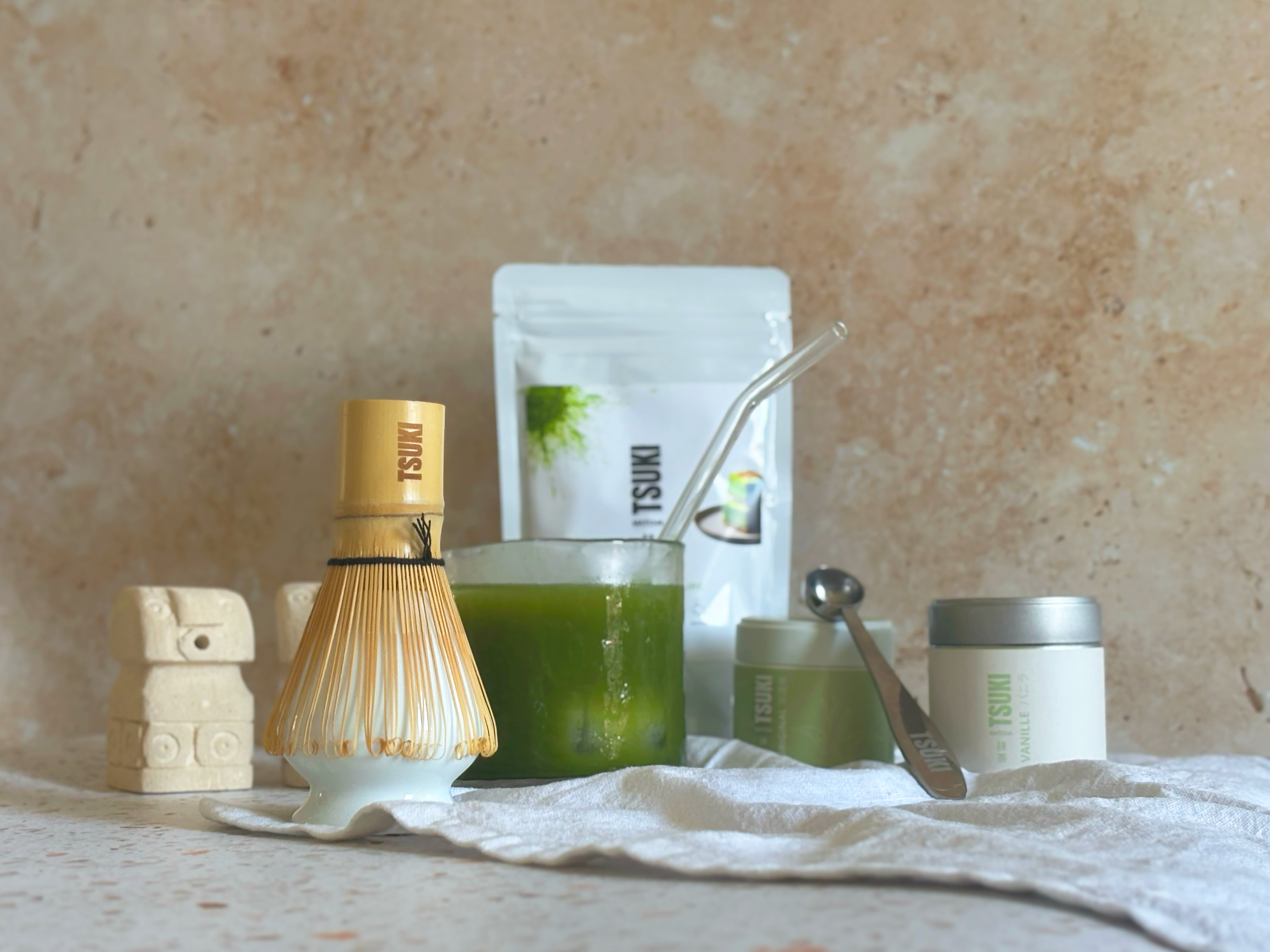

The perfect matcha latte at the coffee shop: the professional recipe and mistakes to avoid
Matcha lattes now account for up to 30% of specialty beverages sold in some urban cafes. However, serving them well, in volume, and consistently requires real technique.
Here is the complete barista guide: precise ratios, exact temperatures, signature variations, and mistakes to avoid to integrate matcha lattes into your menu with specialty coffee quality.

If you manage a coffee shop or specialty cafe, you've probably already added matcha lattes to your menu or are seriously considering it. Good decision: demand has been exploding since 2022, average check sizes are increasing, and matcha customers are generally younger and more loyal than traditional coffee customers. But here's the problem: most cafes serve a technically poor matcha latte. Lumps, bitterness, flat foam, dull color. Not due to negligence, but to a lack of precise information on professional technique.
This article fills that void. This is not a general guide for making matcha lattes at home. It's a technical reference designed for baristas and managers: ratios down to the gram, controlled temperatures, professional foaming technique, signature variations to offer on the menu, and systemic errors that compromise quality when scaling up service volume. Everything you need to ensure your matcha latte is as expertly crafted as your flat white. And everything you need to make sure a customer returns specifically for that matcha.
The fundamentals of professional matcha latte
Before getting into precise ratios, here are four technical principles that distinguish a professional matcha latte from an amateur one.

These fundamentals are non-negotiable: they determine everything else.
1. Matcha quality determines 60% of the result
No technique can compensate for poor quality matcha. This is the starting point. For matcha lattes served in cafes, there are two credible options: ceremonial grade matcha from Japan (Shizuoka, Kagoshima, Uji) for premium menus, or high-quality culinary matcha (not low-end culinary) for larger volumes with a more accessible menu. The distinguishing criterion: vibrant jade green color, not olive green or khaki. To delve deeper into this point, the article on which grade of matcha for professional use details the technical selection criteria.
2. Water temperature is the #1 point of failure
This is by far the most common cause of error. Matcha prepared with boiling water systematically develops bitterness due to the excessive extraction of catechins and tannins. The target: 70 to 80 °C, never above. At this temperature, umami and L-theanine are extracted without burning the powder. If your kettle is not temperature-controlled, let the boiling water sit for 60 to 90 seconds before use.
3. Sifting is not optional
Matcha almost systematically forms lumps if not sifted before adding water. In fast service, many baristas skip this step. This is a mistake. A fine sieve (like a Japanese tea sifter or fine flour sifter) at the station allows for pre-sifting 50 to 100g of matcha in the morning for the day, stored in a separate airtight container. This saves time during service and preserves quality. The visual detail of a latte made without sifting immediately betrays the work to a discerning matcha customer.
4. Matcha is prepared in two steps, never one
Matcha should be whisked with water first, then combined with milk. Never the other way around, never together. Matcha is hydrophobic and does not dissolve properly in milk, especially cold milk. Preparing a concentrated matcha "shot" with water (the equivalent of an espresso shot), then diluting it with milk, is the only method that yields a homogeneous texture.
The reference recipe: dosages, temperatures, ratios
Here are the technical standards used in specialized matcha coffee shops internationally, adapted for French service.

Three recipes to master: hot matcha latte, iced matcha latte, and matcha shot for cocktails and variations.
Hot matcha latte (250 ml serving)
- 3 to 4 g of matcha (depending on desired intensity, 4g = pronounced flavor)
- 40 to 60 ml of filtered water at 75 °C
- 180 to 200 ml of milk, ideally barista oat milk
- Final milk temperature: 60-65 °C (never exceed 70 °C)
- Optional sugar: 5-10g (agave syrup or cane syrup) upon customer request
Iced matcha latte (350 ml serving)
- 4 to 6 g of matcha (iced drinks require a little more matcha to compensate for dilution by ice)
- 60 to 80 ml of filtered water at 75 °C
- 200 to 240 ml of cold milk, preferably barista oat milk
- Ice cubes: a large glass filled, solid ice cubes (no crushed ice, which melts too quickly)
- Prepare matcha with hot water, cool for 30 seconds, pour over ice cubes and cold milk
Matcha shot (for variations and cocktails)
- 3 g of matcha
- 30 to 40 ml of filtered water at 75 °C
- Whisk vigorously for 15-20 seconds with a chasen or electric frother until a stable foam forms
- Used like an espresso shot: cocktail base, dirty matcha (matcha + espresso), for pastry service or as a signature drink
Quick reference table: dosing by serving size
| Size | Matcha | Water at 75°C | Milk | Raw material cost |
|---|---|---|---|---|
| Hot 200 ml | 3 g | 40 ml | 160 ml | ~0,45 € |
| Hot 300 ml | 4 g | 60 ml | 240 ml | ~0,55 € |
| Iced 350 ml | 4-5 g | 60 ml | 220 ml + ice | ~0,55-0,65 € |
| Iced 450 ml | 5-6 g | 80 ml | 300 ml + ice | ~0,70-0,80 € |
For premium culinary matcha purchased in bulk at €150/kg, raw material costs are around €0.45 to €0.80 per drink, sold for €5 to €6: the margin is comfortable. For a more complete analysis, the article on calculating matcha profitability in a cafe details precise margins based on volumes.
Whisking technique in service
Once the powder is sifted and the water at the right temperature, whisk for a maximum of 15 to 20 seconds. Use a quick and straight "W" motion with a chasen, or a high-speed electric frother for high volumes. The goal: fine and homogeneous foam, not large airy foam. If the foam has large bubbles, it means too much air was incorporated or whisking was too slow. The hallmark of well-whisked matcha: a dense, slightly green cream, with no visible particles.
Milk: critical choice for final texture
Matcha is more delicate than espresso: it reacts to the type of milk much more distinctly. Four options for professionals:
- Barista oat milk: Option #1 in most specialized matcha cafes. Natural sweetness that balances the umami of matcha, creamy texture, stable microfoam. This is the standard.
- Barista almond milk: Lighter, roasted notes that pair well with matcha. Less stable foam.
- UHT whole milk: The most stable foam, but can make the matcha profile heavier. To be reserved for customers who specifically request it.
- Barista soy milk: Very good foam, but can curdle if heated too much (above 65 °C). Handle with care.
Coconut, rice, hazelnut: not recommended for standard matcha lattes. They mask the aromas or break the texture. Keep them for specific signature recipes.
The 5 signature variations to offer on your menu
Beyond the basic matcha latte, your menu can include variations that increase the average ticket and differentiate your offering. Here are 5 proven signature recipes from urban coffee shops.
1. Vanilla Matcha Latte
The most universal and easiest variation to sell. Identical recipe to the hot matcha latte, plus 5-8 ml of natural vanilla syrup or 1/4 of a split vanilla bean to infuse in the milk during steaming.

For premium menus, opt for real vanilla bean, which has a much more pronounced taste and justifies a higher price (+€0.50 to €1).
2. Iced Strawberry Matcha Latte (seasonal summer)
One of the most visually striking drinks, perfect for Instagram and thus for word-of-mouth. Pour 30 ml of fresh strawberry puree or strawberry syrup into the bottom of the glass, add ice cubes, then cold milk, then the matcha shot.

Guaranteed "layered" effect. Very good average ticket (often sold for €6 to €7).
3. Dirty Matcha (Matcha Latte + Espresso)
The ideal option for coffee drinkers discovering matcha. 1 single espresso shot poured over a standard matcha latte. The contrast of flavors and colors (brown espresso on green matcha) creates a signature product that retains hybrid customers. Place it on the menu with a short explanatory description.
4. White Chocolate Matcha Latte
For a more gourmet clientele. 10g of white chocolate melted into the milk during steaming, then add the matcha shot. Very creamy, higher ticket, comfortable margin. Excellent as a winter drink to compensate for the seasonal decline in iced matcha.
5. Matcha Tonic (aperitif and afternoon)
A refreshing drink that stands out from the crowd. In a large glass filled with ice: matcha shot (3g + 40ml water), 30ml of ginger or yuzu syrup, topped with tonic water. Guaranteed effervescence, unique aromatic profile, perfect for customers who don't want milk. To be positioned in a separate category on the menu.
The mistakes that ruin quality (and that all cafes make)
Here are the seven systemic errors that degrade the quality of matcha lattes in most cafes. Correcting them often transforms an "average" matcha into an "exceptional" one without any additional cost.
Mistake 1: Boiling water
Mistake #1 by far, as stated in the fundamentals section. If your water comes out of the kettle at 100°C, you burn the powder, extract bitter catechins, and kill the L-theanine. Solution: a temperature-controlled kettle, or wait 60-90 seconds after boiling.
Mistake 2: No sifting
Lumps in the latte = guaranteed customer loss. Sifting takes 5 seconds per drink, or can be pre-done at the start of service. It's non-negotiable.
Mistake 3: Eyeballing ratios without a scale
Measuring "by the spoon" results in 30-50% variations between two baristas, or even between two preparations by the same barista. Consequence: inconsistent quality, the customer never gets the same product twice. A digital scale with 0.1g precision at the station changes everything. Investment: €15-€25. Profitability: immediate.
Mistake 4: Matcha too hot or not whisked enough
If you mix the matcha directly into hot milk, or if you barely whisk it, you get poorly dissolved matcha, a dull color, and a grainy texture. Always prepare a concentrated shot with water first, whisked for 15-20 seconds with a chasen or electric frother.
Mistake 5: Milk too hot
Many baristas heat their matcha milk to the same temperature as milk for cappuccino (65-70°C). This is too hot for matcha. Above 70°C, the matcha in contact with the milk cooks, degrading its aromas and color. Target: 60-65°C for the final milk.
Mistake 6: Matcha exposed to light and air
Matcha oxidizes very quickly in the air. In a cafe, if the matcha container remains open all day behind the bar, or exposed to light, the quality drops within 48-72 hours. Solution: package in small containers (50-100g) hermetically sealed after each use, store in a cool place between services.
Mistake 7: Using bad matcha to save money
A common temptation: using cheap culinary matcha to gain a 30% margin on the drink. Bad calculation: bad matcha results in a bitter, dull drink that doesn't build loyalty. The customer doesn't come back. It's better to use premium culinary or ceremonial matcha, costing €0.50 more per drink in raw materials, which brings back a loyal customer. To frame this economic dimension, the article on the price of matcha per kilo in professional use provides ranges by grade.
Adapting the recipe to service volume
The recipes above work for classic service. During peak hours (morning rush, weekends, tourist season), it's necessary to adapt to maintain throughput without compromising quality.
Pre-sift for the day
The first step to standardize: pre-sift 50 to 100g of matcha in the morning for the day, kept in an airtight container away from light near the station. Benefit: 5 seconds saved per drink, or 50 seconds for 10 drinks, or 8 to 10 minutes per day. Enormous during rush hour.
Pre-dose by weight or volume
For high-volume service, pre-dose "rounds" of 3g and 4g into small connected silicone containers or special spoons with a fixed volume notch. The barista then only needs to grab the correct dose and pour it into the preparation bowl. This pre-organization saves 10-15 seconds per drink. No more variations between baristas.
High-speed electric frother for quick service
The chasen remains ideal for quality, but at high volume (more than 30 matchas/hour), it becomes a bottleneck. Switching to a high-speed electric frother (minimum 25,000 rpm) divides whisking time by 3. Investment: €30-€80 for a durable professional frother.

Qualitative loss is marginal if the machine is of good quality.
Standardize the "matcha shot" order
Borrowing from espresso logic: a "matcha shot" becomes the reference unit (3g + 40ml water at 75°C, whisked for 15 seconds). The entire menu is built from this shot: matcha latte = shot + 160ml hot milk, iced matcha = shot + 220ml cold milk + ice cubes, dirty matcha = shot + espresso, etc. This standardization simplifies training for new baristas and ensures consistency.
Storage and stock rotation
A cafe serving 20-30 matchas per day consumes approximately 60-120g of matcha/day, or 1.5 to 3.5kg/month. To preserve quality, package in sachets of 500g maximum, store in the refrigerator, take out one sachet at a time, and finish it within 4-6 weeks. Beyond that, quality degrades. This rotation is a critical point for product consistency.
Frequently asked questions about matcha lattes in cafes
What is the correct water temperature for a matcha latte?
The target is 70 to 80 °C, ideally 75 °C. Beyond that, you burn the powder and systematically cause bitterness. Below that, extraction is insufficient. If your kettle is not regulated, boil the water and wait 60 to 90 seconds before use.
How much matcha for a latte in a cafe?
3 to 4g for a standard 250-300ml hot latte, and 4 to 6g for a 350-450ml iced latte (iced lattes require more matcha to compensate for dilution by ice cubes). Always measure by weight rather than by spoon for consistency.
Is ceremonial matcha necessary for a cafe, or is culinary sufficient?
It all depends on your positioning. A premium or matcha-centric menu justifies ceremonial matcha from Japan (Shizuoka, Kagoshima, Uji). A broader, high-volume menu works very well with high-quality culinary matcha (not low-grade culinary). In all cases, avoid matcha with no clear origin, or an olive or khaki color.
What milk should I choose for a matcha latte in a cafe?
Barista oat milk is the standard in matcha-centric coffee shops. Its natural sweetness balances the umami of matcha, and its creamy texture creates stable microfoam. UHT whole milk is an alternative; barista soy is possible but should be heated carefully (risk of flocculation above 65°C). Avoid coconut, rice, and hazelnut for the standard recipe.
How much does a matcha latte cost to produce in a cafe?
For a 250ml hot matcha latte with premium culinary matcha purchased at around €150/kg, the raw material cost (matcha + milk + potential syrup) is around €0.45 to €0.55 per drink. Sold at €5 to €6, the gross margin is 85-90%, one of the best on your hot beverage menu.
How to avoid lumps in matcha latte?
Two rules: systematically sift the powder before use (or pre-sift in the morning for the day), and always prepare a concentrated "matcha shot" with hot water first, then dilute it with milk. Never mix the powder directly into milk, especially cold milk.
What equipment is needed to serve matcha latte in a cafe?
Essential: digital scale accurate to 0.1g, temperature-controlled kettle, fine sieve, chasen or high-speed electric frother (minimum 25,000 rpm), preparation bowls, milk pitchers. Startup budget: €200 to €400. For details, see our future article dedicated to matcha equipment for cafes.
How many matchas per day are profitable to serve in a cafe?
From 10-15 matchas per day, the equipment investment pays for itself in less than a month. Cafes well-positioned for matcha serve up to 30-50 matchas per day during peak hours, representing matcha revenue of €150 to €300/day, with a gross margin greater than 85%. An excellent lever for profitability.
Can matcha latte be prepared in advance for the rush?
The matcha shot (matcha + water) cannot be prepared in advance, as the foam collapses within minutes and oxidation begins quickly. However, pre-sifting the matcha and pre-measuring portions can be done at the start of service to save time during rush hour. The final preparation must always be made to order.
How to train a new barista for matcha latte?
Allow 1 to 2 hours of initial training for an experienced espresso barista to understand the specificities of matcha. Points to cover: water temperature, weighing dosage, whisking technique, milk management (max temperature 65°C), systematic sifting. Do 5 to 10 practical preparations under supervision. Consistency then comes with repetition.
Matcha latte is not like other lattes
Matcha latte requires more technical precision than most coffee shop beverages. But once the method is standardized, it is also one of the most profitable and differentiating drinks on your menu. Matcha customers are young, loyal, and willing to pay a fair price for a well-made product. And they immediately notice technical quality: a customer who discovers your well-prepared matcha latte often becomes a regular. The technical standards described here are those used by matcha-centric coffee shops in France and internationally. It's up to you to make them the signature of your establishment.

To start or improve your cafe's matcha offering, the choice of matcha remains the main factor. Our matcha of Japanese origin, specifically selected for professional needs (Yabukita cultivar, ceremonial or premium culinary grade), is designed for regular use in service. Discover our professional area for specific B2B conditions.


