

Iced matcha latte: the summer drink that can double your matcha sales in coffee shops
Caffè Nero sold 1.3 million matcha frappuccinos in three months and saw a 49% increase in iced beverages. Starbucks in the United States generates 75% of its revenue from cold drinks. The iced matcha latte is no longer a seasonal drink; it has become a growth pillar for modern coffee shops. Here's how to make it a revenue driver for summer 2026.

If you manage a coffee shop and look at the figures from major specialized chains, one observation stands out: the transformation of iced beverages into a structural pillar of growth. What was once a seasonal curiosity is now establishing itself as a category in its own right, driven by Generation Z, who drink cold beverages all year round, and by the global explosion of matcha. The iced matcha latte combines both trends. And it probably represents one of the biggest growth opportunities for coffee shops in 2026.
This article dissects this opportunity for managers and baristas: why the iced matcha latte works so well in coffee shops, what the real margin on these drinks is, the six signature recipes to offer on the menu, the operational setup to handle the summer rush, and the choice of matcha best suited for iced recipes. Everything is designed for ideal publication in early May, to prepare for the summer 2026 season.
Why the iced matcha latte is exploding in coffee shops: the numbers to prove it
Before the recipes and implementation, it's important to understand the scale of the phenomenon. These figures are not speculative. They come directly from the financial results and published studies of major global chains.
Growth exceeding all forecasts
Recent market data tells the same story:
- Caffè Nero (UK) announced a record revenue of £166 million in the first quarter of 2026, up 9% year-on-year. The driver? A 49% explosion in iced beverage sales, with 1.3 million matcha frappuccinos sold in three months.
- Starbucks in the United States reported that 75% of its beverage revenue in 2024 came from iced beverages. It's no longer seasonal; it has become the norm.
- The UK iced coffee market shows an average annual growth of 22% over five years. No hot beverage sector is growing at this rate.
- Klatch Coffee (California) indicates that it has quadrupled its matcha sales between 2022 and 2025, with an acceleration of +60% in the last year alone. Their matcha latte is made with oat milk by default, and the iced version is their dominant format.
- National Coffee Association: 49% of young Americans consume iced coffee every day, compared to only 16% of those over 40. Generation Z doesn't drink hot; they drink cold.
- In France, Google Trends confirms the steady progression of "matcha latte," and coffee shop menus are incorporating this drink with a 30% increase in establishments offering matcha in one year.
Why this structural explosion
The conjunction of three factors explains the magnitude of the phenomenon. The generational factor: Generation Z does not perceive cold as a summer drink but as a daily standard. This habit transforms iced beverages into a permanent, not seasonal, category. The social media factor: the iced matcha latte has become an identity accessory on TikTok and Instagram, with its distinctive visual gradients that are difficult to explain in a photo of hot matcha.

The perceived health factor: associated with well-being, gentle energy, and an alternative to sugary coffee, matcha attracts customers who would not consume a classic sugary iced coffee.
For details on customer motivations for matcha, learn why matcha attracts a premium clientele.
The concrete opportunity for a French coffee shop in 2026
For an urban French coffee shop serving between 50 and 200 specialty beverages per day, the iced matcha latte represents a potential of 15 to 30% of the beverage mix in high season, and around 10-15% throughout the year in well-positioned establishments. At €6 per unit, over 300 days of service, this represents an additional revenue opportunity of €9,000 to €35,000 per year, with a gross margin greater than 85%. This is one of the biggest growth levers accessible without major structural investment.
The real margin on iced matcha drinks
Beyond revenue, the iced matcha latte is one of the most profitable drinks you can have on your menu. Let's break down the real margin, with calculations to support it.
Raw material cost per standard iced matcha latte (350 ml)
For a reference recipe (5g premium culinary matcha + 220ml barista oat milk + ice cubes + optional syrup):
- Premium culinary matcha (purchased at around €150/kg in bulk): 5g = €0.75
- Barista oat milk (1L at €2.50): 220ml = €0.55
- Ice cubes (filtered water + production): €0.05
- Optional syrup (agave or vanilla syrup, 10ml): €0.10
- Glass/straw (plastic cup or reusable glass): €0.15
- Total material cost: ≈ €1.60
Sold at an average of €6 in an urban coffee shop, this yields a gross margin of €4.40, or 73%. This is significantly higher than the average margin for a classic cappuccino (around 65%), and much higher than that of an industrial sugary latte. For a complete detail on profitability, learn how to calculate the profitability of matcha in a coffee shop.
Why the margin is higher than hot drinks
Three cumulative reasons. The format is larger (350-450 ml vs 200-250 ml for hot drinks), which justifies a higher price without proportionally increasing the material cost. The accepted pricing is higher: iced customers accept €5.50 to €7 without batting an eyelid, whereas hot matcha often caps at €5-€5.50. Signature variations further increase the average check: an iced strawberry matcha or an iced coconut matcha sells for €6.50 to €7.50, with a few cents of additional material cost.
Average basket naturally increases
A less obvious but very important piece of data: customers who order an iced matcha latte are 40% more likely to order a pastry alongside it than those who order a simple espresso. Why? Because the iced matcha latte is perceived as a moment, not a quick energy boost. Customers settle in, consume slowly, and take their time. This consumption dynamic increases the overall average ticket of your establishment, not just matcha sales.
6 signature recipes for your summer menu
Here are six proven recipes that cover the entire customer spectrum.
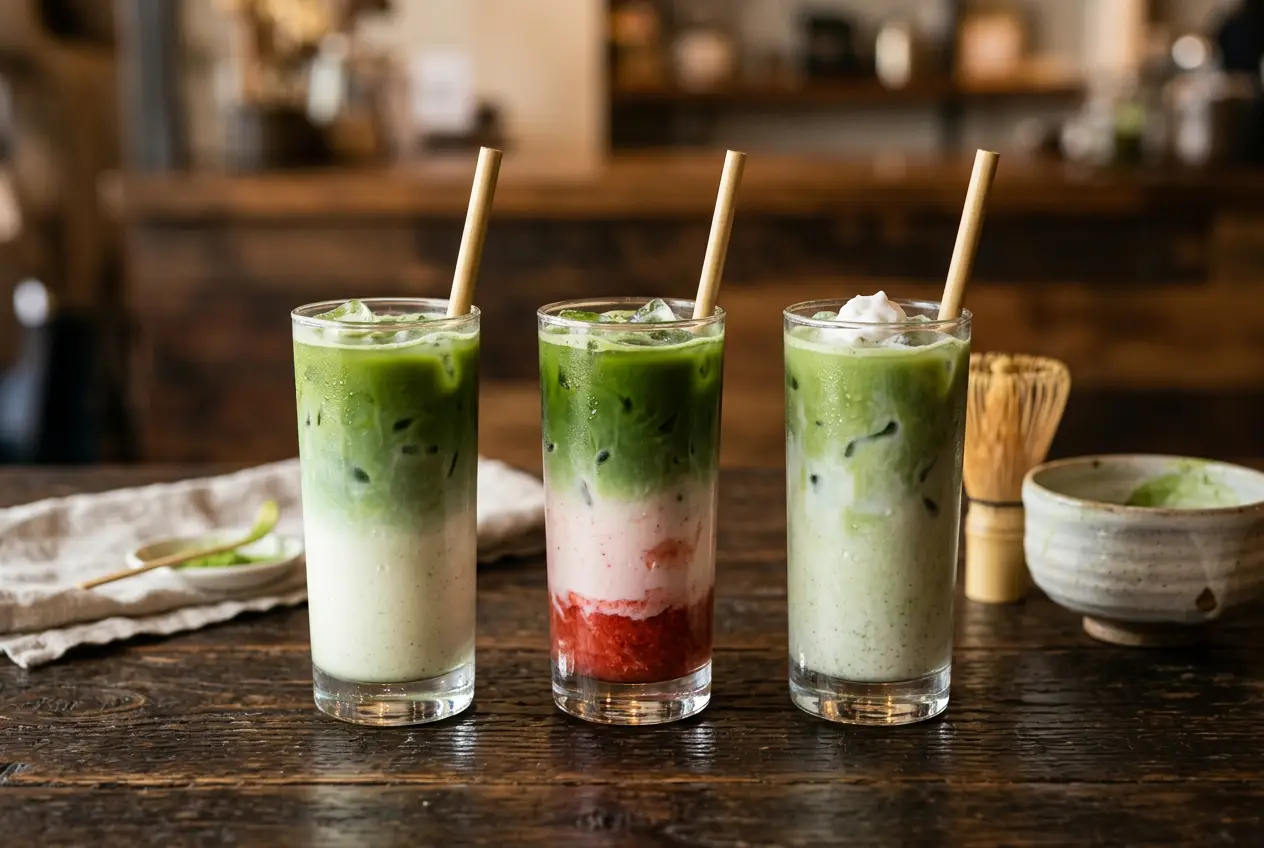
A basic recipe that every coffee shop must master, and five signature variations that differentiate your offer.
Recipe 1: Classic Iced Matcha Latte (the essential base)
The indispensable reference, which must be consistently served to perfection:
- 5g of quality matcha (premium culinary or ceremonial grade)
- 60ml of filtered water at 75°C
- 220ml of cold barista oat milk
- Large 400-450ml glass filled three-quarters with solid ice cubes
- Optional syrup on request (5-10ml)
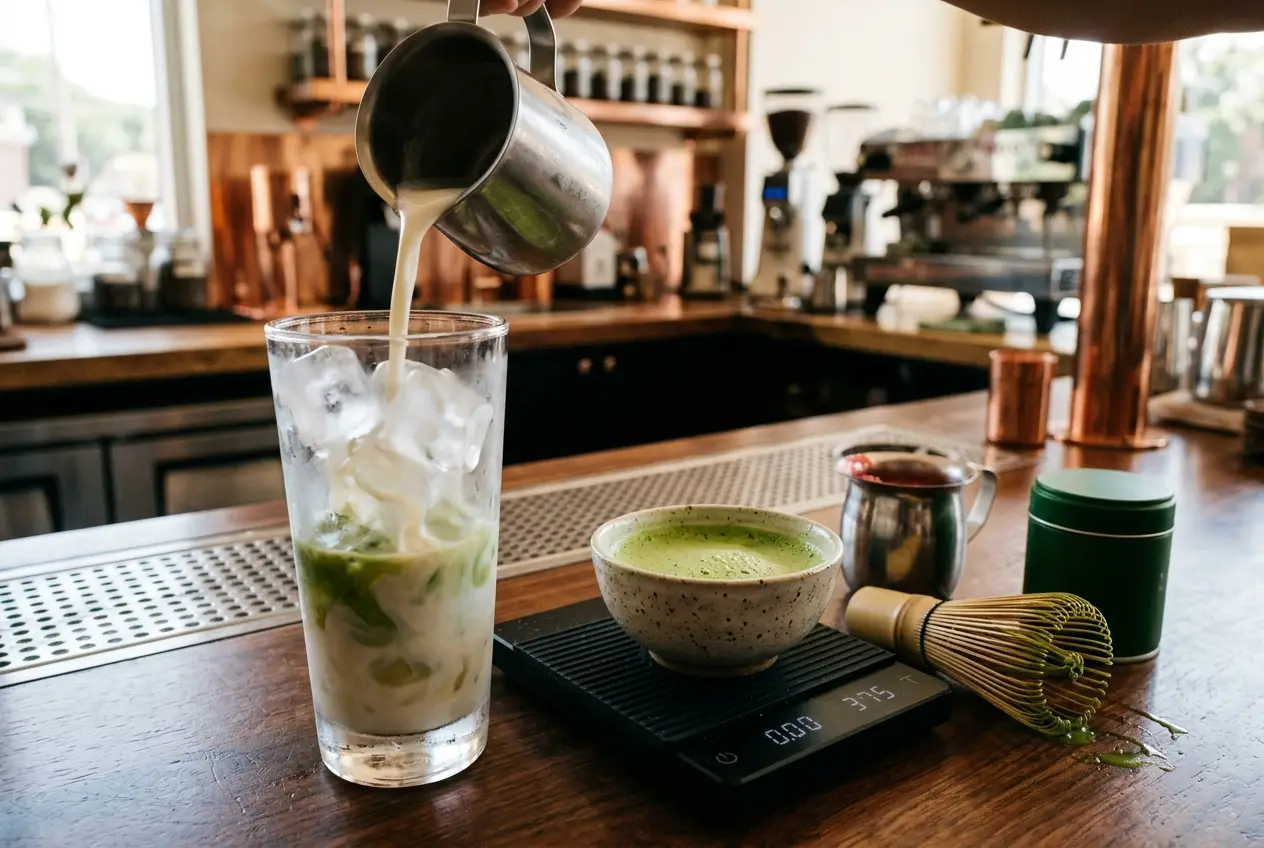
Method: Sift the matcha, whisk with hot water using a chasen or frother for 15-20 seconds to obtain a frothy shot, cool for 30 seconds, pour over ice cubes and cold milk. Natural "layered" effect guaranteed.
Recommended selling price: €5.50 to €6.50 depending on your menu positioning.
Recipe 2: Iced Vanilla Matcha Latte
The most universal variation, which appeals even to customers who don't like pure matcha. Identical to the base recipe, plus:
- 10 ml of natural vanilla syrup (Monin, Routin 1883, or homemade)
- Premium option: 1/4 of a split vanilla pod infused in milk for 2-3 hours before serving
True vanilla justifies a +€1 upcharge. Excellent for premium menus.
Recipe 3: Iced Strawberry Matcha Latte (Seasonal Summer)
Probably the most viral drink on Instagram in 2024-2025, continuing its success. Guaranteed visual effect, highest average basket in the matcha range:
- 30 ml of fresh strawberry puree (ideal in season) or premium strawberry syrup
- Pour into the bottom of the glass, then ice cubes, then cold milk, then matcha shot last
- Three visible layers: pink at the bottom, white in the middle, green at the top
Selling price: €6.50 to €7. Slightly reduced margin (fruit puree = +€0.30 material cost) but significantly higher average basket.
Recipe 4: Iced Coconut Matcha (vegan signature recipe)
For vegan customers and an exotic signature. Base recipe but replacing oat milk with barista coconut milk. Optional: 1 spoonful of whipped coconut cream as a topping. The tropical profile of coconut perfectly complements the umami of matcha.
Selling price: €6.50. Ideal in peak summer season, to be highlighted in the display case.
Recipe 5: Iced Matcha Tonic (afternoon drink without milk)
For customers who don't want milk, or as an original aperitif alternative:
- 3 g of matcha + 40 ml of hot water (the basic matcha shot)
- Large glass filled with ice cubes
- 30 ml of ginger or yuzu syrup
- Topped with tonic water (around 200 ml)
- Thin slice of lime for garnish
Guaranteed effervescence, unique aromatic profile. To be positioned in a separate category on the menu ("milk-free matcha" or "matcha & spirits"). Excellent for targeting a more mature clientele who want something different.
Recipe 6: Iced Dirty Matcha (Matcha + Espresso)
The ideal option for coffee drinkers discovering iced matcha. Base recipe with:
- Prepare the matcha shot + classic iced latte
- Add 1 shot of single espresso (30 ml) poured on top, which slowly sinks and creates color effects
Very good "transition" drink to retain coffee customers who are hesitant about pure matcha. High average basket (€6.50-€7), little additional material cost.
Summary table: margin per recipe
| Recipe | Material cost | Selling price | Gross margin |
|---|---|---|---|
| Classic Iced Matcha Latte | €1.60 | €5.50-€6.50 | 72-75% |
| Iced Vanilla Matcha | €1.75 | €6-€7 | 71-75% |
| Iced Strawberry Matcha | €1.90 | €6.50-€7 | 71-73% |
| Iced Coconut Matcha | €1.90 | €6-€6.50 | 68-71% |
| Iced Matcha Tonic | €1.80 | €6.50-€7.50 | 73-76% |
| Iced Dirty Matcha | €1.75 | €6.50-€7 | 72-75% |
Operational setup: equipment, promotion, pricing
Profitability is excellent, but it can only be unlocked if you maintain pace during service and give these drinks the visibility they deserve. Three operational levers to master.
Specific iced equipment to plan for
Beyond standard matcha equipment, consider:
- Ice machine with sufficient output (calculation: 300g of ice cubes per drink × 50 drinks/day = 15kg of ice cubes/day minimum). If your current machine can't keep up, this is the #1 investment to anticipate. Expect €600-€1,500 for a professional counter-top machine.
- Professional iced glasses: tall glass tumblers of 400-450ml for dine-in service, compostable or reusable cups for take-away. A large transparent glass visually enhances the drink.
- Compostable or stainless steel straws: essential for layered drinks
- High-speed electric frother for peak times (25,000 rpm) — accelerates the matcha shot by 60% compared to manual chasen
- Dedicated stainless steel milk pitchers for cold-froth plant-based milks
To properly launch iced matcha, plan for an additional investment of €800 to €2,000 beyond classic matcha equipment, mainly for the ice machine and iced glassware. Amortization in less than two months for 30 iced matchas per day.
Showcasing in display and on menu
The iced matcha latte is a visual drink. Its commercial strength comes as much from its appearance as from its taste. Five effective showcasing tactics:
- Photo of the drink in the display window, taken in natural light, at eye level. Expect €30 for a laminated A3 print, return on investment in a few extra drinks.
- Service in transparent glass in the dining area, never in an opaque cup. The vibrant green layer over the white milk creates the visual purchase trigger.
- Instagram-ready presentation: finish with a small designer straw and a mint or basil leaf (negligible cost, guaranteed photo + comments).
- Dedicated menu signage "MATCHA SUMMER" or "ICED MATCHA SIGNATURE" separate from the rest of the beverage menu, with photos.
- Barista suggestion at the counter: "Would you like to try our iced strawberry matcha today?" — verbal upsells work particularly well for signature drinks.
Pricing: where to position yourself
Current French benchmarks to frame your iced matcha latte pricing:
- Standard neighborhood coffee shop: €4.50 to €5.50
- Urban specialty coffee shop: €5.50 to €6.50
- Premium and matcha-centric café: €6.50 to €7.50
- Signature variations (strawberry, coconut, dirty): +€0.50 to €1 on the base price
The common mistake is to price too low out of fear. Iced matcha latte customers are less price-sensitive than standard coffee customers. They pay for a signature product and for the visual experience. Under-pricing degrades the perceived value of the product.
Which matcha to choose for iced recipes
A critical choice often poorly managed. For iced recipes, the constraints differ slightly from hot matcha latte.
A premium culinary matcha is sufficient in most cases
For sweetened or flavored iced matcha lattes (vanilla, strawberry, coconut, dirty), a premium culinary matcha from Japan gives excellent results. The presence of sugar and flavors slightly balances the profile, and the higher concentration needed (5-6g vs 3-4g for hot) makes ceremonial use very expensive without noticeable added value.
Ceremonial only for pure iced matcha
For a classic iced matcha latte without syrup or flavoring, where the quality of pure matcha remains central, ceremonial matcha is still justified. The customer then directly identifies the difference in aromatic quality. But this is a minority case in actual iced consumption.
Specific iced selection criteria
- Vibrant green color: essential for visual appeal — a khaki matcha looks bad in superimposed layers
- Good solubility: avoid coarsely ground matchas that clump and dull the foam
- Rather round aromatic profile: less bitter = better hold in the cold (cold amplifies bitterness)
- Verified Japanese origin: Shizuoka, Kagoshima, Uji
To delve into these technical criteria, our article on what grade of matcha for professional use details profiles according to usage.
Estimated order volume for the season
To frame your orders with the supplier, here are the typical volumes of matcha consumed over a summer season (May to September) in a cafe:
- Small cafe (15-20 iced/day): 100g of matcha/day, or 15kg over the season
- Medium cafe (30-50 iced/day): 250g of matcha/day, or 38kg over the season
- High volume (80-150 iced/day): 600g to 1kg/day, or 90-150kg over the season
These volumes also include your hot matchas and pastries. A grouped order directly from a specialized supplier (without an intermediate wholesaler) significantly optimizes the raw material price. Our guide on wholesale matcha from a French wholesaler details professional purchasing conditions.
The implementation schedule for the summer 2026 season
To maximize impact, timing is critical. Here is the ideal deployment plan for having a high-performing iced matcha latte menu as soon as the warm weather begins.
March-April: preparation and orders
Implementation period. Order matcha two months in advance to have stock in time. Train baristas on recipes. Test signature variations on existing clientele. Photograph drinks for promotion. Print window displays.
Early May: official launch
The ideal time to launch the iced matcha latte menu. Temperatures are warming up, customers are looking for new things. Social media communication in the first week with photos of each signature drink. Active barista suggestion for each hot drink order (suggest the iced version).
June-August: optimization and peak
Peak period, where the iced/hot mix can reach 60/40, or even 70/30 in high tourist season. Adjust stock upwards, monitor matcha rotation (consume any open sachet within 4-6 weeks maximum). Test an exclusive seasonal variation (peach-basil matcha, raspberry-rose matcha) to build loyalty and create buzz.
September-October: transition
Keep iced matcha on the menu even after the end of summer. Gen Z customers continue to consume cold drinks in autumn. Potentially reduce the most seasonal variations (strawberry, peach) to keep the permanent ones (classic, vanilla, coconut, dirty).
Frequently asked questions about iced matcha latte in cafes
Is iced matcha latte prepared differently from hot matcha?
The basic technique remains the same: prepare a concentrated matcha shot with hot water (75°C), then dilute it. The difference: the shot must rest for 30 seconds before being poured over ice cubes and cold milk, and the matcha dose is slightly higher (5-6g for a 350ml iced vs 3-4g for a 250ml hot) to compensate for dilution by the ice. Never mix matcha directly with cold milk without a hot water whisking step, otherwise lumps will systematically appear.
What real margin can be made on an iced matcha latte?
For a standard 350ml iced matcha latte with 5g of premium culinary matcha, the cost of ingredients is around €1.60 all-inclusive. Sold for an average of €6, this yields a gross margin of 73%. Signature variations (strawberry, coconut, vanilla bean) maintain a 71-75% margin while increasing the average basket to €6.50-€7. It is one of the most profitable drinks on a cafe menu.
Should ceremonial or culinary matcha be used for iced recipes?
A premium culinary matcha from Japan is generally sufficient for most iced recipes, especially flavored ones (vanilla, strawberry, coconut, dirty). Ceremonial matcha remains relevant only for pure iced matcha without syrup or flavoring, where the quality of the matcha is central. The higher concentration needed for iced (5-6g) makes systematic ceremonial use very expensive without perceptible added value.
Which milk to choose for iced matcha lattes in cafes?
Barista oat milk has become the standard in matcha-centric coffee shops. Its natural sweetness balances the umami of matcha, its creamy texture gives a beautiful visual result, and it works equally well cold or hot. Almond milk is a valid alternative for customers who request it. Coconut milk works for signature coconut recipes. UHT whole milk as an option for traditional customers.
How to prevent iced matcha latte from becoming too diluted?
Three levers. Use large, solid ice cubes, never crushed ice which melts too quickly. Dose slightly more matcha (5-6g instead of 4g for the hot version). Serve immediately after preparation: if the customer takes their drink away, provide a thick straw so they can consume it quickly before dilution.
What are good selling prices for an iced matcha latte in France?
Typical ranges in France in 2026: €4.50 to €5.50 for a standard neighborhood cafe, €5.50 to €6.50 for a specialized urban coffee shop, €6.50 to €7.50 for a premium or matcha-centric cafe. Signature variations can add +€0.50 to +€1. The most frequent mistake is to underprice the product out of fear. The iced matcha customer is less price-sensitive than the standard coffee customer.
Should iced matcha latte be offered year-round?
Yes. The numbers speak for themselves: 49% of young Americans consume their iced coffee every day, all year round. This trend is gradually taking hold in France. Keeping iced matcha latte on the menu off-season builds loyalty among Gen Z and allows testing the depth of the market. The seasonal peak remains May-September, but a significant portion of demand exists from October to April.
How long before serving can an iced matcha latte be prepared?
The matcha shot (matcha + whisked hot water) must be prepared to order. The foam dissipates in 2-3 minutes and oxidation begins quickly. However, you can pre-measure the matcha in doses with a scale, pre-sift the matcha in the morning for the day, and prepare syrups and garnishes in advance. Final preparation should always be à la minute.
Is iced matcha latte compatible with a vegan menu?
Perfectly. With a barista plant-based milk (oat, coconut, almond), iced matcha latte is entirely vegan. It is even one of the strong drinks for this clientele, who are looking for gourmet alternatives to espresso and classic coffee. Many urban coffee shops serve their matcha latte by default with oat milk, and offer animal milk as an option.
How to train a barista in iced matcha recipes quickly?
Allow 1 to 2 hours of training for a barista already comfortable with hot matcha. Specific points to cover: the adjusted dose for iced (5-6g), the 30-second resting period of the shot before pouring, the use of large ice cubes, the pouring order for the layered effect (syrup → ice → milk → matcha), the visual finish. Perform 8-10 practical preparations per signature recipe to internalize the gestures.
Iced matcha latte, a pillar of growth not to be missed
The numbers speak for themselves. Caffè Nero selling 1.3 million iced matchas in a quarter, Starbucks generating 75% of its revenue from cold drinks, Klatch Coffee quadrupling its matcha sales in three years. The iced matcha latte is no longer a seasonal opportunity; it is a structural pillar for cafes that want to remain relevant to today's generation of consumers. The ideal window to get started is now: before the summer 2026 season, with two months of preparation to validate recipes, train the team, and establish the menu. Cafes that catch this wave today capture a clientele that returns year-round. Those who wait another six months will have already lost much of the potential.
For the B2B needs of a cafe preparing for its iced matcha latte 2026 season, our Japanese origin matcha is specifically selected for regular professional use: Yabukita cultivar, premium culinary or ceremonial grade depending on your positioning, traditional stone-ground milling, direct sourcing from the Shizuoka and Kagoshima regions. Discover our pro space or contact our team for B2B conditions and seasonal volumes.


