
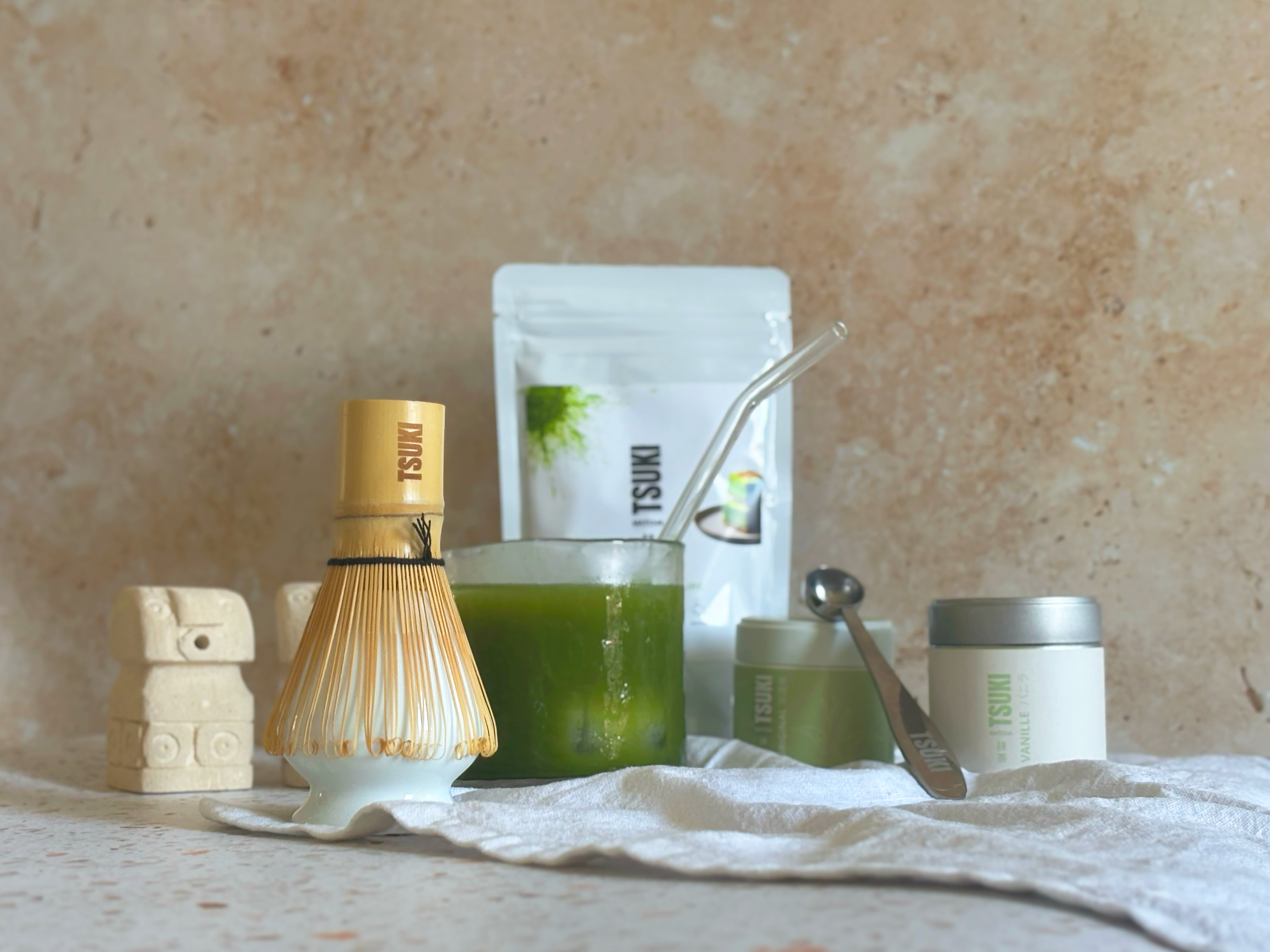

How much matcha per day? Dosage, calories, caffeine
How much matcha should you drink per day? How many grams per cup? How many calories? All the precise answers to incorporate matcha into your daily life in the right quantity, depending on your profile and goals.
Matcha is probably the most nutrient-rich drink on the market. Antioxidants, L-theanine, gentle energy, metabolic support. But as with any caffeinated beverage, the dose makes the poison. Too little, and you don't get the benefits. Too much, and you risk nervousness, sleep disturbances, and discomfort. This article provides precise answers to all dosage questions: how many grams per cup, how many cups per day, how many calories, and how to adjust according to your personal profile.
Matcha quantity per cup: the standard dose
The first fundamental question, independent of the number of cups: what is the right dose of matcha for a single preparation?
The reference dose: 1 to 2 grams per cup
For standard matcha (pure or latte), the reference dose is 1 to 2 grams of matcha per cup.
In concrete terms, this corresponds to a heaped scoop of chashaku (traditional bamboo measuring spoon), or about half a teaspoon.
- 1 g: light dose, ideal for beginners or a mild evening matcha latte (if you tolerate caffeine late in the day)
- 1.5 g: balanced dose, perfect for an everyday matcha latte
- 2 g: full dose, recommended for pure matcha (usucha) or a strong matcha latte
- 3 to 4 g: strong dose, reserved for concentrated ceremonial matcha preparations (koicha) or large iced matcha lattes
Why this dose and no more
As matcha is much more concentrated than classic loose-leaf tea (you consume the entire powdered leaf, not just an infusion), a small dose is enough to get all the benefits. More than 1 to 2 grams per cup does not provide more benefits: the absorption of catechins plateaus, and you only risk increasing bitterness and caffeine intake.
How to dose without a scale
If you don't have a digital scale, there are two simple solutions. First, the bamboo measuring spoon: a heaped scoop of chashaku is equivalent to approximately 1 g, two scoops to approximately 2 g. Second, the half teaspoon: a practical guide for 1 g, to be adjusted according to your preferred dose. However, a scale remains the most accurate solution for perfect consistency between preparations.
How many cups of matcha per day?
Once the dose per cup is mastered, the question of the number of cups per day arises. The answer depends on your profile and your sensitivity to caffeine.
The recommended range for a healthy adult
For a healthy adult, the ideal range is 1 to 3 cups of matcha per day, or 2 to 6 grams of powder in total. This is amply sufficient to enjoy the documented benefits (antioxidants, L-theanine, stable energy, metabolic support) without being exposed to an excess of caffeine.
- 1 cup/day: discovery level, ideal for beginners
- 2 cups/day: optimal level for most regular drinkers
- 3 cups/day: maximum recommended level to enjoy the benefits without risk
For those wondering if daily consumption is compatible with good health, the full analysis on drinking matcha every day, good idea or excess provides all the nuances.
Beyond 3 cups: why it's too much
Drinking more than 3 cups a day does not provide marginal benefit and can lead to undesirable effects. Beyond 400 mg of cumulative caffeine (about 5-6 cups of matcha), you risk nervousness, palpitations, sleep disturbances, sometimes headaches. The higher the total dose, the worse the benefit/risk ratio. All situations to avoid are detailed in the full analysis of matcha side effects according to profiles.
How to distribute your cups throughout the day
The ideal is not just how much but also when. The optimal distribution for 2-3 cups per day:
- First cup: between 7 am and 10 am, to start the day with stable energy
- Second cup: between 1 pm and 3 pm, to get through the afternoon slump
- Third cup (optional): before 4 pm not to disturb sleep
Beyond 4 pm, the caffeine in matcha risks delaying sleep onset. All the details on the best times are in the complete guide on how to drink matcha daily.
Adjusting the dose to your personal profile
The 1-3 cup range suits most people, but some profiles need to adjust.
People sensitive to caffeine
If you are sensitive to caffeine (nervousness, palpitations, disturbed sleep even with a single coffee), start with only one cup per day, dosed at 1 g, in the morning only. Gradually increase only if you tolerate it well. Some people never exceed 1 cup per day, and that's perfectly fine.
Pregnant and breastfeeding women
Recommended limit: 1 cup of matcha per day maximum, at a moderate dose (1-1.5 g). The official caffeine limit during pregnancy is 200 mg/day, and a cup of matcha already provides between 50 and 70 mg. Prioritize morning consumption and always with food. Full precautions for matcha consumption during pregnancy are worth a careful read before incorporating matcha into your routine while pregnant.
Athletes and very active people
Athletes can go up to 3 cups a day without problem, including one cup 30-60 minutes before training to optimize fat oxidation during exercise. High physical activity also facilitates caffeine elimination. Adjust according to personal feeling.
Anxious or hypertensive individuals
More caution is required. Caffeine, even if better tolerated in matcha thanks to L-theanine, can amplify anxiety and raise blood pressure in sensitive individuals. Limit to 1 cup per day, or seek medical advice before introducing matcha into your routine.
Children and adolescents
Matcha is not recommended for children under 12. For adolescents, an occasional small cup is acceptable, but daily consumption should be avoided before age 16, due to increased sensitivity to caffeine and its possible impact on sleep and growth.
How many calories in a matcha?
A frequent question for those watching their diet: what is the caloric cost of matcha?
Pure matcha (without milk)
Pure matcha prepared with water, without added sugar or milk, is virtually calorie-free:
- 1 g of matcha = approximately 3-4 kcal
- 2 g of matcha (full dose) = approximately 6-8 kcal
It is one of the lowest-calorie drinks available, ideal for people watching their weight or wanting to stay in a caloric deficit.

This nutritional characteristic explains why matcha naturally integrates into weight loss efforts, with all the nuances between myth and reality.
Sugar-free matcha latte
With milk but without added sugar:
- With 200 ml of skim milk: approximately 70-80 kcal
- With 200 ml of semi-skimmed milk: approximately 90-100 kcal
- With 200 ml of whole milk: approximately 120-130 kcal
- With 200 ml of oat milk: approximately 80-100 kcal
- With 200 ml of unsweetened almond milk: approximately 30-40 kcal
- With 200 ml of coconut milk: approximately 50-70 kcal

Matcha latte with added sugar
Adding sugar significantly increases the caloric intake. Each teaspoon of sugar adds approximately 16 kcal, each teaspoon of vanilla or agave syrup approximately 20 kcal. A standard vanilla matcha latte in a cafe often totals 150 to 250 kcal.
Starbucks matcha and other commercial versions
For comparison, a Starbucks Grande matcha latte (standard recipe, whole milk) contains 220-240 kcal and 29-32 g of sugar. This is significantly more than the equivalent homemade version. All details are in the full analysis of the composition and calories of Starbucks matcha.
Summary table of calories per preparation
| Preparation | Estimated Calories |
|---|---|
| Pure matcha (water only) | 6-8 kcal |
| Unsweetened almond milk matcha latte | 30-40 kcal |
| Skim milk matcha latte, sugar-free | 70-80 kcal |
| Oat milk matcha latte, sugar-free | 80-100 kcal |
| Whole milk matcha latte, sugar-free | 120-130 kcal |
| Matcha latte milk + 1 spoonful syrup | 140-150 kcal |
| Starbucks Grande whole milk matcha latte | 220-240 kcal (29 g sugar) |
Matcha and caffeine: how much in a cup
Matcha's caffeine is one of its main active ingredients. Here's the exact dose depending on the preparation.
Standard caffeine content
A standard cup of matcha (1-2 g of powder) contains between 50 and 70 mg of caffeine. This is equivalent to a classic espresso. For comparison:
- Matcha cup (2 g): 50-70 mg
- Single espresso: 60-80 mg
- Filter coffee (250 ml): 90-120 mg
- Brewed green tea (250 ml): 30-50 mg
- Concentrated ceremonial matcha cup (koicha, 4 g): 120-140 mg
Why matcha caffeine acts differently
Matcha contains less pure caffeine than coffee at an equivalent dose, but most importantly, its caffeine is released more slowly thanks to the L-theanine present in the tea. The result: stable energy for 3-4 hours, without the typical peak-and-crash of coffee. For full details, see the dedicated analysis on matcha caffeine content.
The limit not to exceed
The recommended caffeine limit for a healthy adult is 400 mg/day. This corresponds to approximately 6 standard cups of matcha, which is well beyond the recommended range of 1-3 cups. As long as you stay within this range, you are well below the limit, even when combined with an occasional coffee.
Special case: the dose of concentrated ceremonial matcha (koicha)
For advanced enthusiasts, there is a more concentrated traditional preparation called koicha (thick matcha), used in authentic Japanese tea ceremonies.
The koicha ratio
For 1 cup of koicha:
- 4 g of premium ceremonial matcha (never culinary grade, the profile is not suitable)
- 30-40 ml only of water at 75 °C
- Thick, almost syrupy texture
- Intense profile, concentrated umami, little bitterness if the matcha is excellent
Koicha is not an everyday drink: it is a tasting reserved for contemplative moments and special occasions. Not to be confused with the standard dose.
Frequently asked questions about matcha dosage
How much matcha per cup?
The standard dose is 1 to 2 grams of matcha per cup, or about one heaped scoop of chashaku or half a teaspoon. 1 g for a mild latte or for beginners, 2 g for pure matcha or a strong matcha latte. A digital scale is the most accurate tool for dosing, but a bamboo measuring spoon remains a practical alternative.
How much matcha can you drink per day?
For a healthy adult, 1 to 3 cups per day (2 to 6 g of matcha in total) is the ideal range. Beyond that, you risk excessive caffeine intake without additional benefits. Pregnant women should limit themselves to 1 cup per day, and anxious or hypertensive individuals should be more cautious.
How many calories in pure matcha?
Pure matcha prepared with water, without sugar or milk, contains approximately 3 to 4 kcal per gram of matcha used, or 6-8 kcal for a standard 2 g cup. It is one of the least caloric beverages available, ideal for people watching their weight.
How many calories in a matcha latte?
It depends on the milk and added sugar. Without sugar, a matcha latte has 30-40 kcal with almond milk, 70-80 kcal with skim milk, 120-130 kcal with whole milk. With a spoonful of syrup or sugar, add 15-20 kcal. A Starbucks Grande matcha latte can exceed 240 kcal with 29 g of sugar.
How much caffeine in matcha?
A standard cup of matcha (1-2 g) contains 50-70 mg of caffeine, equivalent to a classic espresso. Matcha caffeine is released slowly thanks to L-theanine, which provides stable energy for 3-4 hours without the peak-and-crash of coffee. The recommended daily caffeine limit is 400 mg.
Can you drink 5 cups of matcha a day?
It is not recommended. Beyond 3 cups a day, you risk excessive caffeine intake (300+ mg accumulated just from matcha) which can cause nervousness, palpitations, sleep disturbances, and headaches. Benefits do not accumulate linearly with dose: 2-3 cups well distributed throughout the day offer an optimal balance between benefits and comfort.
What dose of matcha for weight loss?
2 to 3 cups of matcha per day, ideally distributed with one cup 30-60 minutes before physical exercise to optimize fat oxidation during effort. The dose itself is not a magic factor: it is the integration of matcha into a balanced diet and regular physical activity that makes the difference.
Should I take the same dose every day?
No, it is not necessary. The dose can vary according to needs and time: 1 cup on calm days, 2-3 cups on active or intense work days. The important thing is to stay within the recommended overall range (1-3 cups) and to listen to your body. If you feel nervousness or sleep disturbances, it is a sign to reduce.
Does matcha contain sugar?
No, pure matcha contains no sugar. It is simply green tea leaves ground into powder, with less than 0.5 g of carbohydrates per cup. Any sugar in a matcha latte comes solely from what is added (syrup, honey, vanilla sugar) or naturally present sugars in milk.
The right dose for the right effects
Matcha is one of the beverages that rewards moderation the most. At the right dose (1-2 g per cup, 1-3 cups per day), it offers stable energy, increased concentration, concentrated antioxidants, without significant caloric cost. Too much, it becomes counterproductive. Too little, it doesn't offer much. The secret is not to drink as much as possible, but to integrate it sustainably into a rhythm that suits you. With good quality matcha from Japan and the right amount, matcha becomes a real pillar of your well-being routine.

To integrate matcha into your daily life with a quality product, discover our selection of premium matcha from Japan (Yabukita cultivar, traditional stone-ground, ceremonial or premium culinary grade depending on your use).


