

Matcha scoop (chashaku): dosage, selection and use
The bamboo measuring spoon is not just a detail. It determines the dosage, the preservation of matcha, and the ritualistic gesture.
Here's everything you need to know about the chashaku: how many grams per cup, why bamboo instead of a metal spoon, and when to use a proper measuring spoon.
The role of the chashaku
The chashaku is a small, tapered bamboo spoon, carved from a single piece, about 18 cm long. It has accompanied matcha since the origins of the tea ceremony in Japan. Its function is threefold.
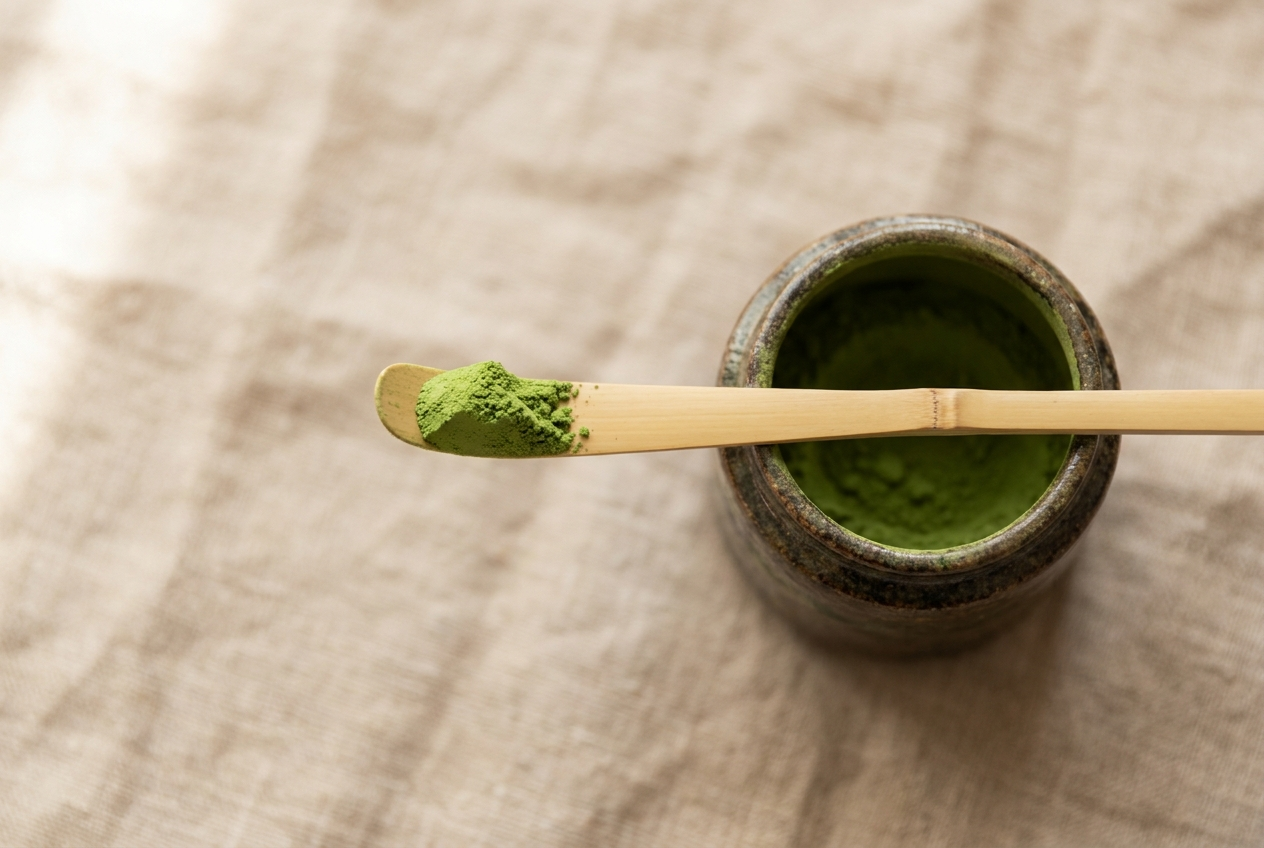
Consistent dosing. A level chashaku holds approximately 1g of matcha. Two scoops provide the 2g needed for a standard bowl. The motion is precise, reproducible, without needing a scale. It's the daily measuring tool for serious enthusiasts.
Preserving the powder. Bamboo is neutral, dry, and perfectly inert in contact with matcha. A metal spoon, even a clean one, can transfer metallic flavors or accelerate the oxidation of the powder at the point of contact. This invisible detail becomes noticeable over time, especially with premium ceremonial matcha.
Integrating the gesture into the ritual. In the Japanese ceremony, each tool plays a dramatic role. The light and silent chashaku contributes to the calmness of the gesture. At home, it serves the same function: to slow down, measure, and cherish the moment.
To understand how the chashaku fits with the other tools of the ritual, the guide to essential matcha accessories details each piece and its usefulness.
How many grams of matcha per cup
The correct dosage depends on the preparation. Here are the references to know.
| Preparation | Quantity | Chashaku equivalent | Teaspoon equivalent |
|---|---|---|---|
| Usucha (light matcha) | 1 to 2 g | 1 to 2 level scoops | 1 level teaspoon |
| Koicha (thick matcha) | 3 to 4 g | 3 to 4 level scoops | 2 level teaspoons |
| Matcha latte | 1.5 to 2 g | 1 to 2 scoops | 1 level teaspoon |
| Pastry (cake, cookies) | 6 to 10 g | weigh on scale | 2 to 3 teaspoons |
| Smoothie | 1 to 2 g | 1 to 2 scoops | 1 level teaspoon |
Usucha ("light" matcha) is the most common preparation. This is what is meant when we simply talk about "matcha." 80 ml of water at 70-75 °C for 2 g of powder, whisked into a fine foam. This is the ratio to remember.
Koicha ("thick" matcha) is rarer, more concentrated, almost syrupy. Reserved for ceremonial moments and very high-quality ceremonial matcha. The whisking technique is different, and the powder needs to be impeccable.
For baking, forget the chashaku: we're talking about several grams at once, so a scale is more precise. The chashaku is still useful for adjusting at the end of a recipe if necessary.
For the complete whisking technique, the guide how to prepare matcha tea step by step details each movement after dosing.
Bamboo spoon vs. measuring spoon
The question often arises. Three concrete differences are worth detailing.
Dosing precision. A chashaku is calibrated to hold about 1g. A measuring spoon holds exactly 1g, making the measurement exact. With a teaspoon, you tend to dose too much or too little, and the consistency from one matcha to another suffers. With a chashaku or a measuring spoon, the dosage is reliable to the scoop.

Preservation of matcha. Matcha oxidizes on contact with air, and even more so on contact with materials that retain moisture or odors. A clean metal spoon is technically neutral, but it can introduce fine electrostatic vibrations that cause powder loss, and it retains food odors better if it's not dedicated. Bamboo, dry, odorless, neutral, is the perfect ally for matcha. You store it with your matcha container, and you take it out with it.
Ritual. This is less technical, but it matters. Taking out a chashaku, lifting the lid of the container, scooping two portions into the bowl: the gesture takes three seconds, but it marks the transition between routine and the matcha moment. It's a detail that changes the quality of attention you give to the preparation.
For beginners, here's the simple rule: if you consume matcha more than once a week, the chashaku pays for itself immediately. For occasional use, a clean, dry teaspoon dedicated to matcha will suffice.
How to use your chashaku properly
The gesture is simple, but a few best practices enhance the experience.
Dip the chashaku perpendicularly into the matcha, without digging. Gently lift and tap twice on the edge of the container to release excess powder. The scoop is then "level."
Aim for the correct quantity on the first try. For a standard bowl of usucha: 2 level scoops. Avoid turning the spoon multiple times in the container, which stirs the powder and promotes oxidation.
Then sift directly into the bowl. The chashaku does not replace the sieve: it measures, the sieve breaks up clumps. The two tools are complementary.
Wipe the chashaku with a dry cloth after use. Absolutely no water: the bamboo would retain it, swell, and eventually crack.
Store it in the matcha container or next to it, in a dry place. It is one of the most durable accessories in all equipment: a good chashaku lasts for years.
How to choose a good chashaku
Not all chashaku are created equal. Four criteria to consider.
Material. Solid bamboo, carved from a single piece. Avoid lacquered wood versions (which can release residue) or assembled wood (more fragile, less aesthetic). Susuyake bamboo, naturally smoked, is a Japanese standard.
Shape. A traditional chashaku has a gentle curve with a slight angle in the middle, and a small, tapered "head" at the end. This shape is not decorative: it allows the spoon to rest balanced on the edge of the container and to measure cleanly.
Length. 18 cm is the standard. Too short, it won't reach the bottom of a container. Too long, it becomes uncomfortable.
Finish. A well-made chashaku has a smooth finish to the touch, with no splinters or visible glue. The bamboo should have a warm, natural hue, not an overly varnished appearance.
In terms of budget, expect 5 to 10 € for a good artisanal chashaku. Beyond that, you're paying for a signature or rare bamboo (sometimes justified for a collector's item, rarely useful for daily use).
To understand how the chashaku fits into the complete chain of tools, the guide complete method for preparing matcha tea details each step, from dosing to tasting.
FAQ: Matcha spoon
How much matcha is in a chashaku measuring spoon?
About 1g level. This is the reference measurement universally used by Japanese producers and enthusiasts. Two scoops give 2g, which is the standard dose for an 80ml bowl of usucha.
Can a regular teaspoon be used instead of a chashaku?
Yes, the matcha will be fine. The chashaku remains preferable for three reasons: dosing precision, powder preservation, and ritual dimension. For occasional use, a dedicated, dry teaspoon is sufficient. For regular use, the chashaku quickly pays for itself.
What is the difference between chashaku and chasen?
The chashaku is the bamboo measuring spoon. The chasen is the bamboo whisk used to mix the powder with water. Two different tools, two complementary uses.
How long does a chashaku last?
Several years if well-maintained: wiped dry after use, stored in a dry place, never washed with water. It is one of the most durable accessories in the matcha kit.
Should the chashaku be washed?
No. Simply wipe it with a dry cloth after use. Water damages the bamboo and eventually deforms it. If it really gets dirty (wet powder, splashes), quickly rinse it under a stream of water and dry immediately.
How much matcha per cup for beginners?
2g for a standard bowl (about 80ml of water). This is equivalent to 2 level chashaku scoops or one level teaspoon. Below this, the taste lacks presence; above it, bitterness takes over.
Can matcha be measured with a scale?
Yes, it's even the most precise method. For baking, where we're talking about 6 to 10g, a scale is essential. For daily bowl preparation, the chashaku is faster and largely precise enough.
In summary
The chashaku is not a decorative accessory. It measures, preserves the powder, and structures the gesture. For regular consumption, it pays for itself in a few weeks and accompanies your matcha for years.
The key takeaway: 1g per scoop, 2 scoops for an usucha, 3 to 4 scoops for a koicha, weigh on a scale for baking.
Want to equip your ritual with a measuring spoon? Discover the TSUKI measuring spoon, or explore the complete TSUKI matcha collection to accompany your dosage.


