
Home
›
Everything about Matcha
›
Kusmi Tea Matcha, Palais des Thés and Dammann Frères: how good are the matchas from big tea brands?

Kusmi Tea Matcha, Palais des Thés and Dammann Frères: how good are the matchas from big tea brands?
on May 25 2026
All major French tea houses sell their own matcha. But are these brands, known for their black teas and Earl Greys, also relevant when it comes to matcha? An honest analysis of Kusmi Tea, Palais des Thés, and Dammann Frères matcha: origin, grade, price per kilo, real quality.
When looking for matcha in France, the first reflex is often to turn to the big tea houses we already know. Kusmi Tea with its colorful tins, Palais des Thés and its elegant boutiques, Dammann Frères and its bicentennial history. These brands have all added matcha to their catalog, riding the trend that has been steadily growing since 2020. The logic seems obvious: if a brand masters black tea and green tea, it must master matcha too. The reality is more nuanced. Matcha is not a tea like any other. It requires very specific expertise, from sourcing to processing, which has nothing to do with that of loose leaf teas.
This article objectively analyzes the matcha offered by the three largest French tea houses. Declared origin, grade, price per kilo, transparency of product sheets, feedback from independent testers. The goal is not to disparage these brands, which remain excellent in their core business. It is to provide the tools to compare their matchas with other options, and to make an informed choice. Because the difference between a generic tea brand matcha and a specialized brand matcha is evident from the first cup.
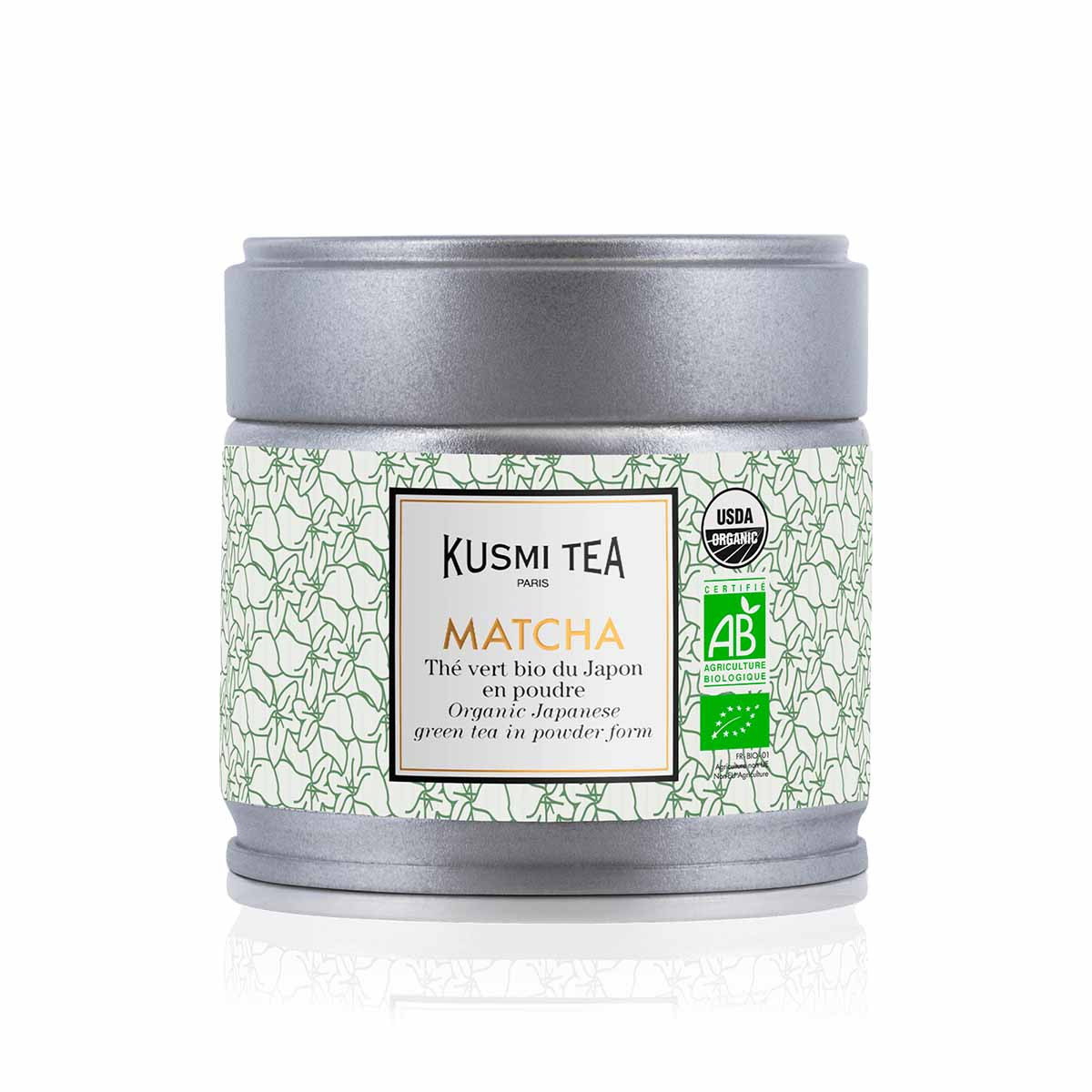
Kusmi Tea matcha: what is it really worth?
Kusmi Tea is probably the most visible tea brand in France for the past fifteen years. Designer tins, massive distribution, careful communication. Its organic matcha is widely distributed. Let's see what you get in concrete terms.
Declared composition and origin
According to the official information available on the Kusmi Tea website, the matcha sold under the brand is an organic powdered green tea from Japan, ground between two granite blocks. The product sheet mentions traditional production, carefully picked leaves, and flat drying before grinding. Good technical foundations.
But here's what's missing from this presentation. The precise Japanese region of production is not mentioned (no specific Uji, Shizuoka, Kagoshima, Nishio). The exact grade is not clearly indicated (premium ceremonial, standard ceremonial, or culinary). The cultivar used is not specified either. For a brand that positions itself on quality, this is not very detailed, especially compared to the standards of matcha specialists who always communicate on these points.
The price per kilo
Kusmi Tea matcha is sold for around €19 per 100g in certain distribution channels, which is €190/kg. This price is very low for a matcha presented as organic Japanese. For comparison, a ceremonial matcha of quality origin Shizuoka or Kagoshima is generally between €400 and €800/kg depending on the grade. At €190/kg, we are talking about culinary or entry-level ceremonial matcha, which is not a problem in itself, but should be known.
What users and testers say
Independent feedback on Kusmi matcha converges on a few points: correct color without being vibrant, classic vegetal taste without great umami subtlety, acceptable foam when whisked. It is a functional matcha, which does the job for a latte or a pastry, but does not offer the experience of a ceremonial matcha. The discovery set (matcha + chasen + chashaku) is however well thought out for beginners who want a complete first kit.
Kusmi Tea assessment
Kusmi matcha is a decent mass-market product, designed for lattes and cooking. A good entry point for those who just want to try it without investing. Not the right choice for those looking for the authentic taste of ceremonial matcha. The brand does not communicate enough on the technical parameters that distinguish an exceptional matcha from a standard matcha.
Palais des Thés matcha: the most complete range
Palais des Thés traditionally positions itself as a more specialized house, with a real educational commitment to teas from around the world.
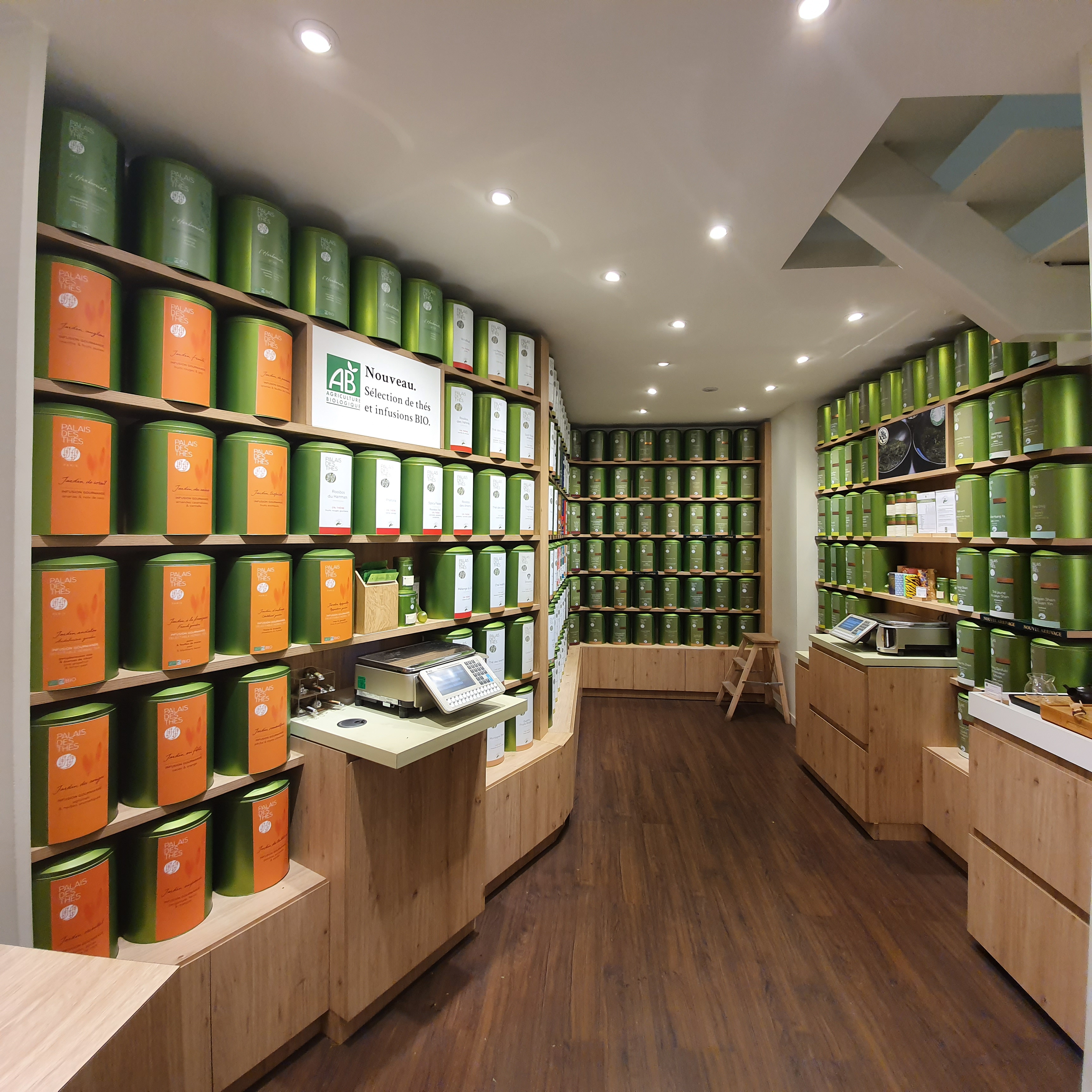
Its matcha range is also the most diverse of the three brands studied.
Three main references
Palais des Thés offers several matchas that correspond to three distinct uses:
- Organic Matcha Latte: specifically designed for matcha lattes, with a milder formulation. Warning, the official product sheet explicitly states that this matcha is not suitable for traditional preparation (with pure water). An honest clarification, but one that sheds light on its entry-level positioning.
- Organic Imperial Matcha: the brand's "classic" reference, sold for €20.50 per 40g (i.e., €512/kg). Presented as tonic, round, mellow, with vegetal and umami notes. Produced from tencha with three weeks of shading before harvest.
- Matcha Shiri Grand Cru: the premium range, at €45 per 40g (i.e., €1,125/kg). Presented as a grand cru, ceremonial tasting level.
Transparency: better than Kusmi, still perfectible
Palais des Thés communicates better than its competitors on production: three weeks of shading, use of tencha, fine grinding. The brand also offers educational content on traditional preparation, ceremony, and techniques. However, the regional origin is rarely specified (occasional mention of "Japan" without a specific region). For Sencha Matcha (blend), the Kyushu region is cited, but for pure matchas, the origin remains generic.
The real value for money
The Organic Imperial Matcha at €512/kg is at the high end of premium culinary matchas, or the low end of ceremonial matchas. At this price, one expects a truly high-quality tasting matcha. Independent reviews describe it as correct, without being exceptional. The Matcha Shiri at €1,125/kg is more engaging, but at this price level, it competes directly with specialized Shizuoka/Kagoshima matchas that can offer better for the same budget.
Palais des Thés assessment
Probably the best matcha offer among the major French tea houses, especially thanks to the diversity of the range and a real educational effort. But the lack of precision on regional origin and cultivar remains a weakness for a product positioned on quality. At this price level, you can clearly find better from matcha specialists.
Dammann Frères matcha: the historic brand with the weakest matcha commitment
Dammann Frères is the oldest French tea house, founded in 1825. Its expertise in black teas and flavored blends is undeniable.

When it comes to matcha, the results are more mixed.
The three Dammann references
The brand currently offers three matchas:
- Matcha Grand Cru Minami Yamashiro: €41 for 20g, or €2,050/kg. This is the high-end reference, presented as an exceptional tea.
- Uji Tasting Matcha: €23 for 20g, or €1,150/kg. Uji region indicated, which is a positive point.
- Pastry Matcha: 100g sachet for about €30, or €300/kg. For cooking, more economical but with limited tasting quality.
Origin and transparency
Dammann more clearly mentions the production regions for its premium matchas (Minami Yamashiro, Uji) than its competitors. These two regions are prestigious in Japanese matcha. This is a real positive point compared to Kusmi. However, the exact grade (ceremonial or not) remains poorly detailed on the product sheets.
The problem with independent testing
Independent feedback on Dammann matcha is more mixed than one might expect given the price. The Tasting Matcha at €1,150/kg is described in several tests as having a pale color and a light, almost diluted taste, out of step with its premium positioning. At this price level, one expects a matcha that rivals the best specialist references. This is rarely the case.
Dammann Frères assessment
The image and packaging are impeccable. The geographical precision on the regions is a strong point. But the real value for money remains low compared to specialist matchas at the same price. The house remains excellent on black teas and aromatic blends. Matcha is not its main area of expertise, and it shows in the final product.
Comparative table: the three brands versus a specialist matcha
| Criterion | Kusmi Tea | Palais des Thés | Dammann Frères | Matcha specialist brand |
|---|---|---|---|---|
| Regional origin specified | No (generic Japan) | Partial | Yes (Uji, Minami Yamashiro) | Yes (Shizuoka, Kagoshima, etc.) |
| Cultivar indicated | No | No | No | Yes (Yabukita, Okumidori…) |
| Grade clearly named | No | Implicit (Latte / Imperial / Grand Cru) | Implicit (Pastry / Tasting / Grand Cru) | Yes (ceremonial / culinary) |
| Price per kilo (premium range) | ~€190/kg | €512 to €1,125/kg | €1,150 to €2,050/kg | €400 to €900/kg for ceremonial grade |
| Organic certified | Yes | Yes | Depending on reference | Often yes |
| Traditional tasting advice | Generic | Detailed | Basic | Very detailed (core business) |
| Real color (vibrant jade green) | Correct | Good (Imperial) | Average (independent tests) | Characteristic jade green |

Tea brand vs. matcha brand: why specialization changes everything
Beyond the reference-by-reference comparison, there is a fundamental logic to understand. Why would a brand that sells a hundred different tea references be less good at matcha than a brand that only sells matcha? The answer lies in four concrete points.
1. The specific expertise of matcha sourcing
Matcha is not a tea you buy like an Earl Grey. You need to know the individual Japanese producers, select the right cultivars according to the annual batches, and negotiate directly for tencha lots before grinding. A brand that also selects Darjeeling, Lapsang Souchong, and Pu-erh cannot have this level of depth specifically for matcha. It sources through intermediate wholesalers, which reduces the leeway for final quality. To learn more about this issue, the guide on how to choose good matcha details all the criteria that make the difference.
2. Stock rotation
Matcha is extremely sensitive to oxidation. Ideally, it should be consumed within 6 to 12 months of production, and within 4 to 6 weeks of opening. A specialized brand moves its stock quickly and renews its batches regularly. A generalist brand, where matcha is just one reference among hundreds, will inevitably have slower rotation. The product ages in store, losing color, aromas, and nutritional properties.
3. Transparency on technical parameters
Specialized brands systematically communicate on the region, cultivar, harvest date, and grade. This information is essential for comparison and selection. Generalist brands remain vague because their expertise does not cover these details. When you read "organic matcha from Japan" without further precision, you know you are dealing with a standardized product, not a specialized selection.
4. Grinding mastery
All brands claim their matcha is stone-ground, but the devil is in the details: rotation speed (true traditional grinders run at a maximum of 30 rpm, producing only 30-40g per hour), exit temperature, fineness of the powder. A specialized brand masters these parameters or chooses suppliers who respect them. A generalist brand more easily accepts industrial compromises that degrade the final quality.
The result in the cup
Concretely, you perceive the difference from the first tasting: a more vibrant color for specialist matcha, a creamier texture, a more pronounced umami presence, and a longer finish. You don't need to be an expert to feel it. A simple side-by-side test between a specialist matcha and a tea brand matcha immediately reveals the gap. Visual evaluation is even an excellent first filter, as detailed in the article on the color of matcha and what it reveals.
Should you buy your matcha from a tea shop or an online specialist?
A practical question for many consumers.

Here are the real advantages and disadvantages of each option.
Buying from a tea shop (Kusmi, Palais, Dammann)
Advantages: you see, you touch, sometimes you taste on site. Reassuring setting, immediate advice, known brand image. Practical for those who just want to try without committing.
Disadvantages: matcha often stored longer in stores, slow rotation, actual quality often lower than what the price suggests, little technical transparency, limited range.
Buy online from a matcha specialist
Advantages: fast stock rotation, complete traceability (region, cultivar, date), often better price for equivalent quality, direct producer sourcing, precise technical advice. Everything is clearly explained in guides such as the one on where to buy matcha in France.
Disadvantages: no physical contact with the product before purchase, initial trial a bit of a commitment for a beginner.
The best strategy
For an exploratory trial on a small budget, a discovery format from an online specialist is smarter than buying from a generalist tea brand. The value for money is better, stock rotation is faster, and you discover the true potential of matcha rather than a diluted version. Once the brand is found, online repurchase is effortless. To delve deeper into this comparison, the article on the best matcha of 2026 and its comparison lists the references to prioritize.
Frequently asked questions about matcha from major tea brands
Which is the best matcha among Kusmi, Palais des Thés and Dammann?
Among these three brands, Palais des Thés offers the most complete and transparent range, with a real educational effort. Dammann has the best origin display (Uji, Minami Yamashiro) but mixed feedback on value for money. Kusmi remains the most accessible entry-level option but also the most standardized. None of the three truly compete with a specialized brand's matcha.
Is Kusmi Tea matcha good quality?
Kusmi matcha is a decent product for general public use: matcha latte, pastry, first trial. Organic, Japanese origin. However, it is not designed for pure ceremonial use, and its grade remains vague. At around €190/kg, it is an entry-level or culinary matcha, not a premium ceremonial one.
Why is Palais des Thés matcha expensive?
The Imperial Matcha at €512/kg and Shiri Matcha at €1,125/kg reflect the brand's positioning on quality, careful packaging, marketing, and physical store distribution. For equivalent quality, you can find a specialist matcha from Shizuoka or Kagoshima origin between €400 and €700/kg, often with superior transparency on cultivar and harvest.
Is Dammann Frères matcha worth its price?
The value for money of Dammann matcha is considered disappointing by several independent testers. At €1,150/kg for the tasting matcha, an exceptional product is expected, which is not always the case according to feedback. The brand remains excellent for black teas and aromatic blends, but matcha is not its historical forte.
Why don't these brands provide the exact region of the matcha?
Because their sourcing generally goes through intermediary wholesalers rather than direct relationships with producers. Without direct contact with the farm, exact geographical precision is difficult to guarantee from batch to batch. Specialized brands that source directly from Japanese producers, on the other hand, can detail each reference (region, cultivar, harvest, etc.).
What alternative would you recommend to a beginner?
A discovery format from an online matcha specialist, with a transparent technical sheet (regional origin, cultivar, clearly named grade). The entry cost is often comparable, or even lower, than that of classic tea brands, with superior actual quality. A discovery set with accessories (chasen, chashaku) also allows for a serene approach to the subject.
Is organic matcha from tea brands really better?
The organic label guarantees the absence of pesticides, which is important for a whole ground tea (you consume the leaf, not an infusion). But organic says nothing about the grade, regional origin, cultivar, freshness. It is one criterion among others, not a guarantee of taste quality. A generic organic matcha can be less good than a non-organic matcha but of excellent origin, and vice versa.
How long does a tea brand's matcha keep after opening?
Like all matcha, ideally 4 to 6 weeks after opening, stored in the refrigerator in its original airtight container. Beyond that, the color dulls, the aromas degrade, and the properties diminish. Palais des Thés also indicates this recommendation on some of its datasheets (45 days after opening), which is a good indicator of the product's fragility.
Expertise is cultivated: making your choice knowingly
Buying your matcha from Kusmi Tea, Palais des Thés or Dammann Frères is perfectly legitimate. These houses are references in tea culture in France, their image is solid, their shops well located, their communication careful. But for matcha in particular, the verdict is clear: you often pay the price of a specialized product without truly getting the quality. For those who want to discover matcha without knowing much about it, it's acceptable. For those who really want to taste the best of what matcha has to offer, it's better to turn to brands whose sole business it is. The difference is seen, felt, and tasted. And an equivalent price will offer you a much finer product.
For a matcha of Japanese origin with complete transparency on the region, cultivar and grade, discover our selection of premium matcha, sourced directly from producers in the Shizuoka and Kagoshima regions. Yabukita cultivar, traditional stone mill grinding, free shipping from €50.


