
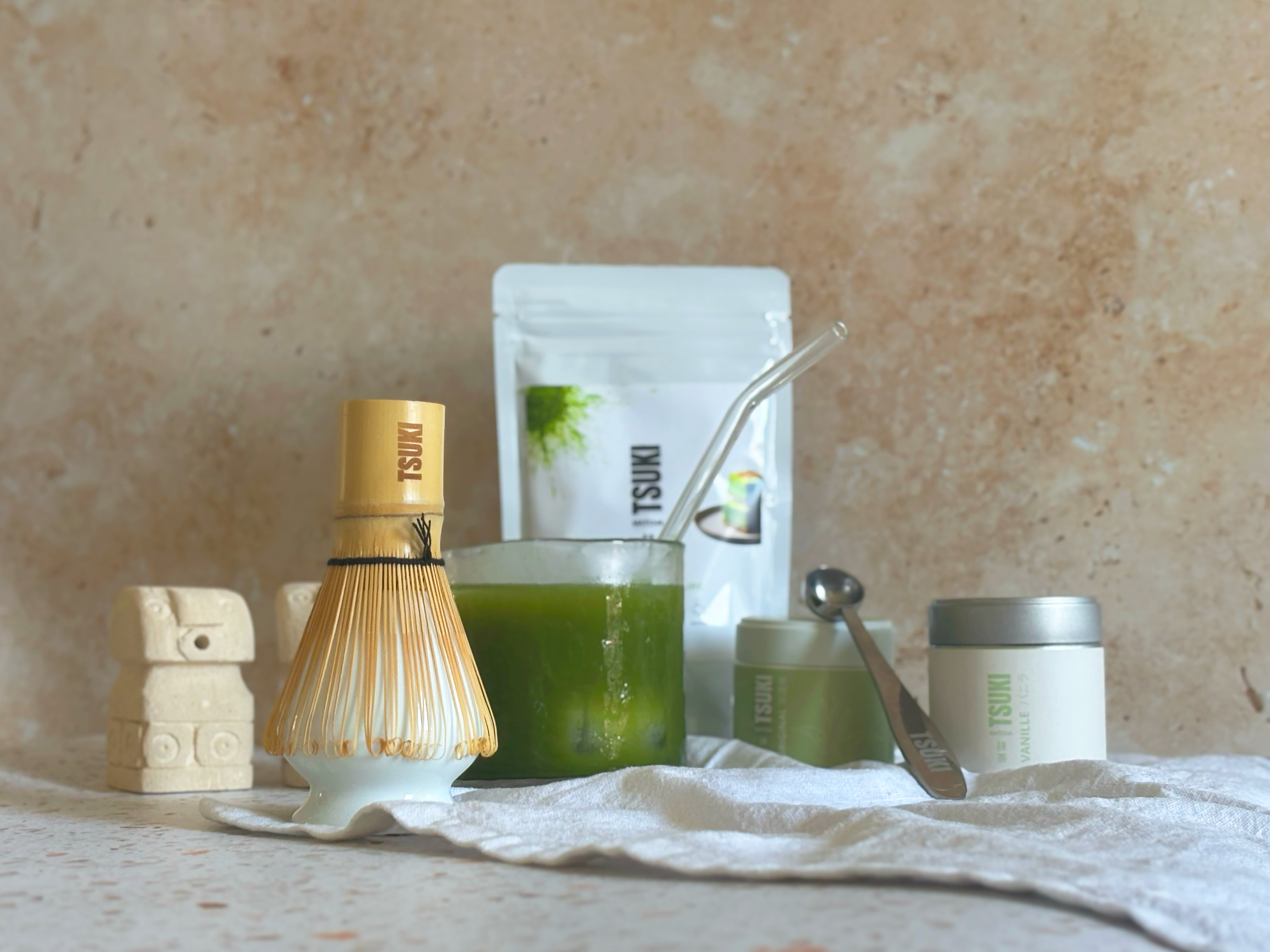

How to make a homemade matcha latte (without a machine)
Matcha lattes cost €5-€7 in coffee shops. Prepared at home, it costs less than one euro, requires no special equipment, and often yields better results.
Here is the complete recipe, the right dosage, the technique that makes all the difference, mistakes to avoid, and all hot or iced variations.
What you need
A matcha latte is made with four basic ingredients and one essential tool.
Matcha (1.5 to 2g per cup). For a latte, culinary-grade matcha is perfectly sufficient. There’s no need for premium ceremonial grade; the milk masks the fine nuances. The essential criterion remains the color: vibrant green from the start, otherwise your latte will be dull.

Hot water (30 ml). Filtered if possible, never boiling. The right temperature: 70-75 °C, which is just before simmering, or boiling water cooled for 1 minute.
Milk (200 to 250 ml). Oat, almond, soy, coconut milk, or semi-skimmed cow's milk. The choice radically changes the result. More details in the variations section.
A sweetener (optional). Cane syrup, honey, maple syrup. 5 to 10g according to your taste.
For equipment, you have several options depending on what you have available.
The bamboo whisk (chasen). The traditional tool, the most effective for fine, homogeneous foam. This is the one that gives the best result.
A mini electric milk frother. Sold for around €10, very effective for quick use. The debate between the two options is settled in the article electric whisk vs bamboo chasen.
A shaker or a sealed jar. A perfectly valid workaround. Just shake vigorously for 30 seconds.
To go further without specific equipment, the guide how to prepare matcha without a whisk details three alternative methods.
Hot matcha latte in 4 steps
Step 1 - Sift the matcha
Pass 1.5 to 2g of matcha (about 1 chashaku scoop, or 1 level teaspoon) through a small fine sieve, directly into a bowl or large cup. This step takes 5 seconds and changes everything: without sifting, the matcha forms lumps that never completely dissolve.
Step 2 - Prepare the matcha base
Pour 30 ml of water at 70-75 °C over the matcha. Whisk immediately with a chasen in a rapid W motion for 15 to 20 seconds. The paste should become smooth, shiny, with a fine foam on top.

No chasen? The mini electric whisk does the job in 10 seconds, or the shaker solution shaken for 30 seconds.
This concentrated base is the central element of the latte. If it's lumpy, your latte will be too. If it's smooth, the rest follows.
Step 3 - Heat and froth the milk
Heat 200 to 250 ml of milk in a small saucepan to about 65 °C (just before simmering). Too hot, the milk loses its aromas and the natural sugar caramelizes.
For frothing without a machine: pour the hot milk into a sealed airtight jar and shake vigorously for 30 seconds. Or use the mini electric whisk directly in the pitcher or cup. An airy foam almost doubles the volume of the milk.
Step 4 - Assemble the latte
Gently pour the hot frothed milk over the matcha base. If you want to sweeten, add cane syrup or honey directly to the milk before pouring. Stir gently with a spoon.
For a more visual effect, keep the foam until the last moment and spoon it on top. You get the classic cappuccino look, in jade green version.
For the complete whisking technique, the guide how to prepare matcha tea step-by-step guide details each movement.
Iced matcha latte in 3 steps
The cold version is even faster. Ideal on hot days, and the degraded green on white visual effect is unbeatable.

Step 1. Sift 2g of matcha into a bowl, add 30 ml of water at 70-75 °C, whisk for 15 seconds to obtain a smooth base. Yes, we use hot water even for the iced version: this is what properly dissolves the matcha. The contrast with cold milk and ice lowers the temperature in a few seconds.
Step 2. Fill a large glass three-quarters full with ice cubes. Pour 200 ml of cold milk over it. Add syrup if you're sweetening.
Step 3. Slowly pour the matcha base over the milk, ideally against the side of the glass or over an ice cube. Since matcha is slightly denser, it floats on the surface for a few seconds before sinking. Stir just before drinking.
To explore the iced version in all its details, the article iced matcha latte recipe: the perfect recipe details the variations (dirty matcha, frappé, raspberry).
Choosing your milk: what really changes
The choice of milk changes everything: the texture, the taste, the color of the final latte. Here are the main options.
Oat milk (recommended). Creamy, naturally slightly sweet, froths well. It's a coffee shop favorite for good reason. Prefer barista versions, which are richer.
Almond milk. Lighter, more subtle. Highlights the vegetal notes of matcha. Ideal for those who find other milks too rich.
Soy milk. Neutral, protein-rich, froths very well. It's the Japanese standard for matcha lattes.
Coconut milk. Adds a tropical roundness that transforms the latte into an almost dessert-like drink. Very good in an iced version.
Semi-skimmed cow's milk. Creamy, classic. Whole milk is too rich, skimmed milk lacks body.
For a detailed comparison, the guide which milk to choose for your matcha lattes provides tasting notes for each option.
The 5 mistakes that ruin your matcha latte
Five mistakes consistently reappear in initial attempts. Easy to avoid once identified.
1. Boiling water. Above 80 °C, matcha becomes bitter and loses its aromas. Aim for 70-75 °C, which is water just before simmering, or boiling water cooled for 1 minute in an open kettle.
2. No sifting. Matcha naturally compacts in its packaging. Without sifting, lumps remain in the bowl even after whisking. 5 seconds of sifting solves the problem.
3. Too little matcha. Below 1.5g, the matcha gets lost in the milk and results in a bland latte. The right dose for 200-250 ml of milk: 2g, which is 1 well-filled chashaku or 1 level teaspoon.
4. Overheated milk. Above 65 °C, milk loses its aromas, natural sugar caramelizes, and the foam collapses. The rule: the saucepan should never simmer. Turn off the heat as soon as the first small bubbles appear.
5. Pouring matcha onto milk before whisking. Wrong order. The matcha base should always be prepared first, perfectly smooth, in its own bowl. You then add it to the milk, not the other way around. Otherwise, you get lumpy greenish milk that looks unappetizing.
Customization variants
Once the basic recipe is mastered, several variations are worth trying.
Vanilla matcha latte. Add 1 teaspoon of natural vanilla extract to the milk before heating. Vanilla softens the bitterness and gives it a pastry-like touch.
Honey-cinnamon matcha latte. 1 teaspoon of honey + 1 pinch of cinnamon in the milk. More comforting, perfect for winter.
Dirty matcha latte. An espresso shot poured over the matcha latte. Three-layer visual effect, intense taste where coffee and matcha complement each other.
White chocolate matcha latte. Melt 1 square of white chocolate in the hot milk before preparing the latte. The sweetness of white chocolate perfectly balances the matcha.
Which matcha to choose for lattes
Matcha latte is more forgiving than pure matcha: milk, optional sugar, and foam soften the edges. There's no need to invest in premium ceremonial grade.
A quality culinary matcha (specified Japanese origin, vibrant green, stone-ground) is the right choice. It retains color in the glass, has enough presence not to get lost in the milk, and the cost per latte remains reasonable: about €0.15 to €0.25 of matcha per cup.
To understand how to sort through the options, the guide how to choose a good matcha: complete guide details the criteria. And for those who want to understand the ritual dimension beyond the latte, the guide matcha tea ceremony: immersive guide opens up the traditional Japanese world.
The best homemade matcha tea preparation guide brings together all best practices to go beyond the latte.
FAQ: homemade matcha latte
How much matcha for a latte?
1.5 to 2g per 250ml cup. This is about 1 chashaku scoop or 1 level teaspoon. Below that, the taste gets lost in the milk. Above that, bitterness takes over.
Can you make a matcha latte without a chasen whisk?
Yes, absolutely. A mini electric whisk costing €10, a sealed shaker shaken for 30 seconds, or even an airtight jar will do the job. The chasen remains the reference tool for foam quality, but it's not essential to get started.
Can I use any milk?
Yes, all milks work. Oat milk and soy milk produce the best foams. Almond milk is lighter, coconut milk is more exotic. Semi-skimmed cow's milk remains a safe classic.
Should I sweeten my matcha latte?
It's a matter of taste. Good quality matcha doesn't necessarily need to be sweetened; its umami notes are sufficient. For beginners, 5g of cane syrup or honey rounds out the flavor. Avoid powdered sugar, which doesn't dissolve well in cold liquid.
Why is my matcha latte bitter?
Three main causes: water too hot (above 80 °C), too much matcha, or poor quality matcha to begin with. Check these three points, and the bitterness should disappear.
How long does it take to prepare a matcha latte?
3 to 4 minutes in total. 30 seconds for sifting and whisking, 1 minute to heat the milk, 30 seconds to froth, 1 minute to assemble the glass. Faster than a coffee machine with a frother, and much cheaper.
Does matcha latte make you gain weight?
An unsweetened oat milk matcha latte contains about 100-130 kcal, which is less than a classic cappuccino. The unsweetened almond milk version drops to 50-70 kcal. It's the addition of sugary syrups in coffee shops that turns the drink into a caloric dessert.
In summary
Homemade matcha latte can be made without special equipment, in 3 minutes, for less than one euro. Four ingredients (matcha, water, milk, optional sugar) and a simple tool (bamboo whisk, mini electric whisk, or shaker) are enough.
The golden rules: sift the matcha, never exceed 75 °C for water and 65 °C for milk, use 2g of matcha for 250ml of milk, and prepare the matcha base before assembling the drink.
With quality culinary matcha, barista oat milk, and a whisk (even improvised), the result often surpasses that of coffee shops, for a fraction of the price.
Want to try with a matcha that keeps its color in the glass? Discover TSUKI's selection of premium matchas, sourced from Shizuoka and Kagoshima, Yabukita cultivar, stone-ground, perfect for everyday lattes.


