
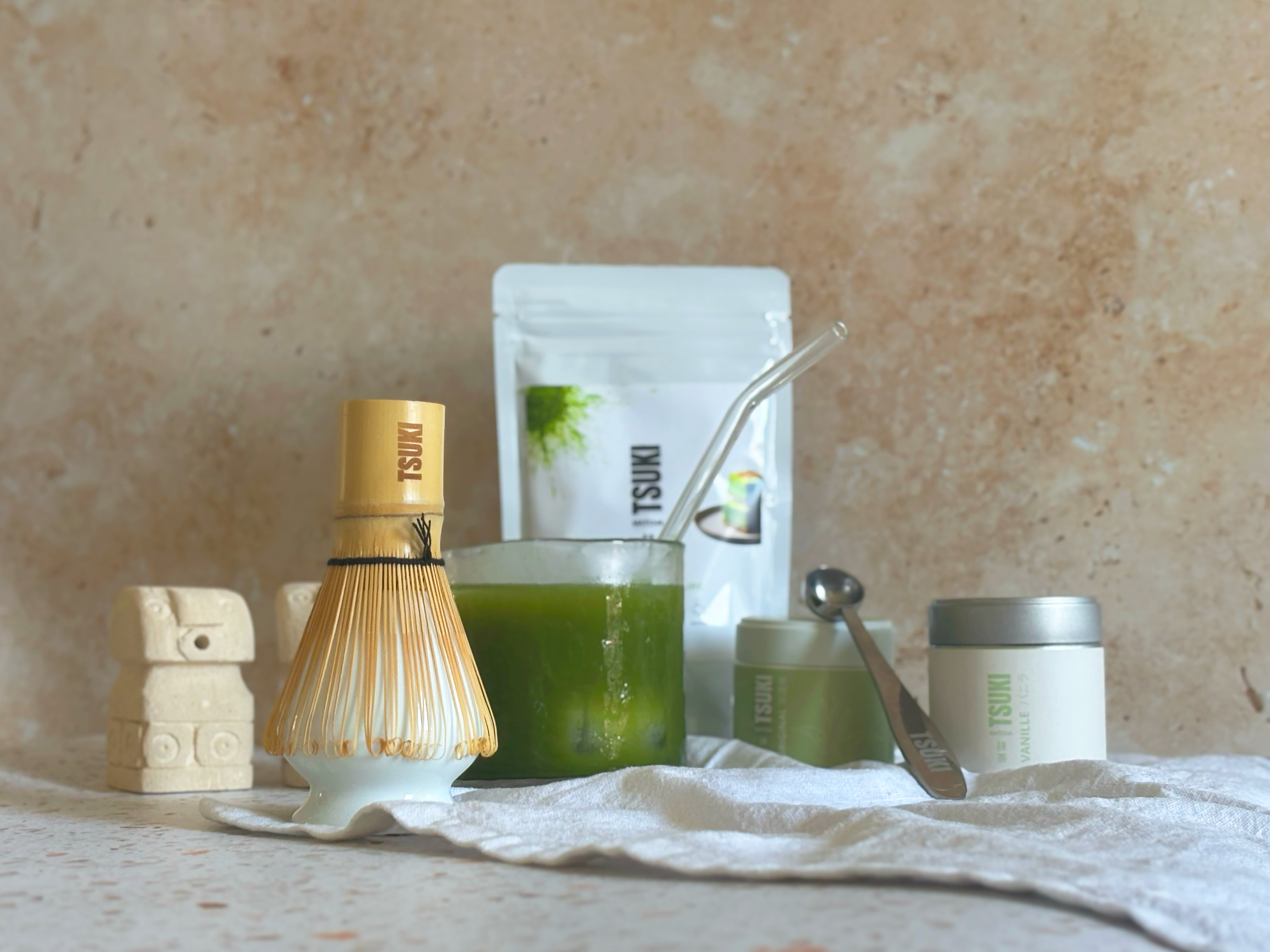

Matcha Collagen: Benefits, Recipe, and Our Opinion
Matcha collagen is one of the most sought-after wellness duos of 2026. On one side, a Japanese green tea rich in antioxidants.
On the other, a structural protein essential for skin, joints, and hair. Together, these two ingredients form a powerful synergy.
This guide explains why this combination works, how to prepare it at home, and which matcha to use for optimal results.
Why combine matcha and collagen
Matcha and collagen act on complementary mechanisms. Matcha protects. Collagen rebuilds. Together, they form a duo that works on two fronts simultaneously.
Matcha is exceptionally rich in catechins, particularly EGCG (epigallocatechin gallate). These antioxidants neutralize free radicals, unstable molecules that accelerate cell aging, including skin cells. In parallel, EGCG helps protect existing collagen fibers in the body from degradation caused by oxidative stress.

Collagen, for its part, provides the amino acids necessary for the regeneration of skin, joints, and connective tissues. With age, natural collagen production decreases by about 1% per year starting from age 25. This gradually leads to loss of skin firmness, appearance of wrinkles, and weakening of joints.
By combining the two, matcha protects existing collagen while collagen supplementation compensates for the decline in natural production. It is this double action that makes the matcha collagen duo so relevant.
Benefits of the matcha collagen duo
Skin: radiance, firmness, and hydration
This is the most documented benefit. Hydrolyzed collagen peptides support skin elasticity and firmness. Clinical studies over 12 weeks of supplementation show measurable improvements in skin elasticity.
Matcha complements this action in several ways. Its catechins protect the skin against UV damage (without replacing sun protection). Its vitamin C helps reduce pigment spots. Its vitamin E promotes deep hydration. And its chlorophyll, present in large quantities thanks to leaf shading, helps eliminate impurities and give a radiant complexion.
The matcha beauty routine is also very widespread in Southeast Asia.
Joints and mobility
Collagen is a major structural component of cartilage. Hydrolyzed collagen supplementation is often recommended to support joint health, especially in active individuals or with age.
Matcha brings its natural anti-inflammatory properties here. Green tea catechins help reduce chronic inflammation, a factor that accelerates cartilage degradation. This is a particularly interesting combination for athletes. To learn more, read our article on matcha for athletes.
Energy and concentration
Beyond skin and joints, matcha collagen offers a benefit that collagen alone cannot provide: a gentle and lasting energy. The combination of caffeine and L-theanine specific to matcha promotes a state of calm alertness, without nervousness or crash. It is an ideal drink for the morning or early afternoon.
Metabolism
Matcha is known for its effect on thermogenesis. EGCG helps stimulate metabolism and promote fat oxidation. Collagen, rich in glycine and proline, supports lean muscle mass. Together, they contribute to a more active metabolism as part of a healthy lifestyle. To go further, consult our article matcha and metabolism.
Recipe: matcha collagen latte
Preparing a matcha collagen latte at home is simple. The key is to dissolve the collagen in hot water before adding the matcha, as powdered collagen mixes better in a hot liquid.

Ingredients
1.5 to 2 g of matcha (one level teaspoon), 10 g of hydrolyzed collagen powder (marine or bovine depending on your preference), 30 to 50 ml of hot water (70-75 °C), 200 ml of milk of your choice (oat, almond, or whole milk), a sweetener of your choice (optional).
Preparation
Pour hot water into a bowl. Add the collagen powder and stir with a spoon until completely dissolved. Quality hydrolyzed collagen dissolves in a few seconds without lumps.
Add the sifted matcha to the same bowl. Whisk vigorously with a chasen (bamboo whisk) for 15 to 20 seconds, making M or W movements. You will get a homogeneous, slightly frothy green liquid.
Pour hot or cold milk into a cup. Add the matcha-collagen mixture on top. For the iced version, fill the cup with ice cubes before pouring in the cold milk, then add the matcha collagen.
If you want to sweeten it, add a drizzle of honey, agave syrup, or maple syrup.
Variations
Vanilla version. Replace plain matcha with TSUKI Vanilla matcha. Its biscuity notes pair perfectly with collagen for an even more gourmet latte, without added sugar.
Smoothie version. Blend matcha, collagen, a banana, 200 ml of almond milk, and a few ice cubes in a blender. You get a thick and nutritious matcha collagen smoothie, perfect for breakfast.
Comforting hot version. Prepare the matcha collagen with hot oat milk and a pinch of cinnamon. Ideal for winter evenings.
Which matcha to use for a matcha collagen?
The quality of the matcha is crucial in this preparation. Powdered collagen has a relatively neutral taste, which means that matcha will be the ingredient that defines the flavor profile of your drink.
Poor quality matcha will result in a bitter latte, even with collagen and milk. Ceremonial grade matcha, which is mild and not very bitter, will offer a balanced and pleasant result.
At TSUKI, our ceremonial grade matchas are cultivated in Japan (Yabukita cultivar), shaded before harvest, and ground with a stone mill. Their mild and balanced profile makes them an ideal base for a matcha collagen latte.
The Original matcha offers fresh vegetal notes and a pure taste that allows the collagen to integrate without flavor conflict. The Vanilla matcha adds a natural gourmet dimension that makes the drink even more enjoyable daily.

Avoid culinary matcha for this preparation. Its more robust and astringent taste does not pair as well with collagen in a drink.
FAQ: matcha and collagen
Does matcha destroy collagen?
No, quite the opposite. Matcha antioxidants, especially EGCG, protect collagen fibers from degradation caused by free radicals. Matcha is an ally of collagen, not its enemy. This is why the two complement each other so well.
Should I buy an all-in-one "matcha collagen" product?
Not necessarily. All-in-one products are convenient but often involve compromises: the matcha used is rarely ceremonial grade, the collagen dosage can be low, and some contain sugar or artificial flavors. The best approach is to choose a quality matcha and pure hydrolyzed collagen separately, then mix them yourself. You retain full control over quality and dosages.
How much collagen per day?
The generally recommended dose in studies is 5 to 10 g of hydrolyzed collagen per day. Effects on the skin are usually observed after 8 to 12 weeks of regular consumption. A daily matcha collagen latte with 10 g of collagen is a simple and pleasant way to reach this dose.
Can matcha collagen be taken in the evening?
Matcha contains caffeine (30 to 50 mg per cup). If you are sensitive to caffeine, avoid consuming your matcha collagen after 2-3 PM. Collagen alone has no stimulating effect and can be taken at any time. If you want to take collagen in the evening, simply mix it with water or a glass of milk, without matcha.
Is matcha collagen suitable for vegans?
Matcha is 100% plant-based. Collagen, however, is an animal protein (marine or bovine). There is no truly vegan collagen. Some brands offer plant-based "collagen boosters" (vitamin C, hyaluronic acid, silica) that support the body's natural collagen production. Matcha, rich in vitamin C and antioxidants, is already an excellent natural collagen stimulator.
Does matcha collagen help with weight loss?
Matcha stimulates metabolism thanks to EGCG, and collagen promotes satiety due to its protein content. Together, they can support a weight management goal as part of a balanced diet and active lifestyle.
Want to try the matcha collagen duo? Start with a TSUKI ceremonial grade matcha as a base, add your favorite collagen, and enjoy a drink that benefits your skin, joints, and energy.


