
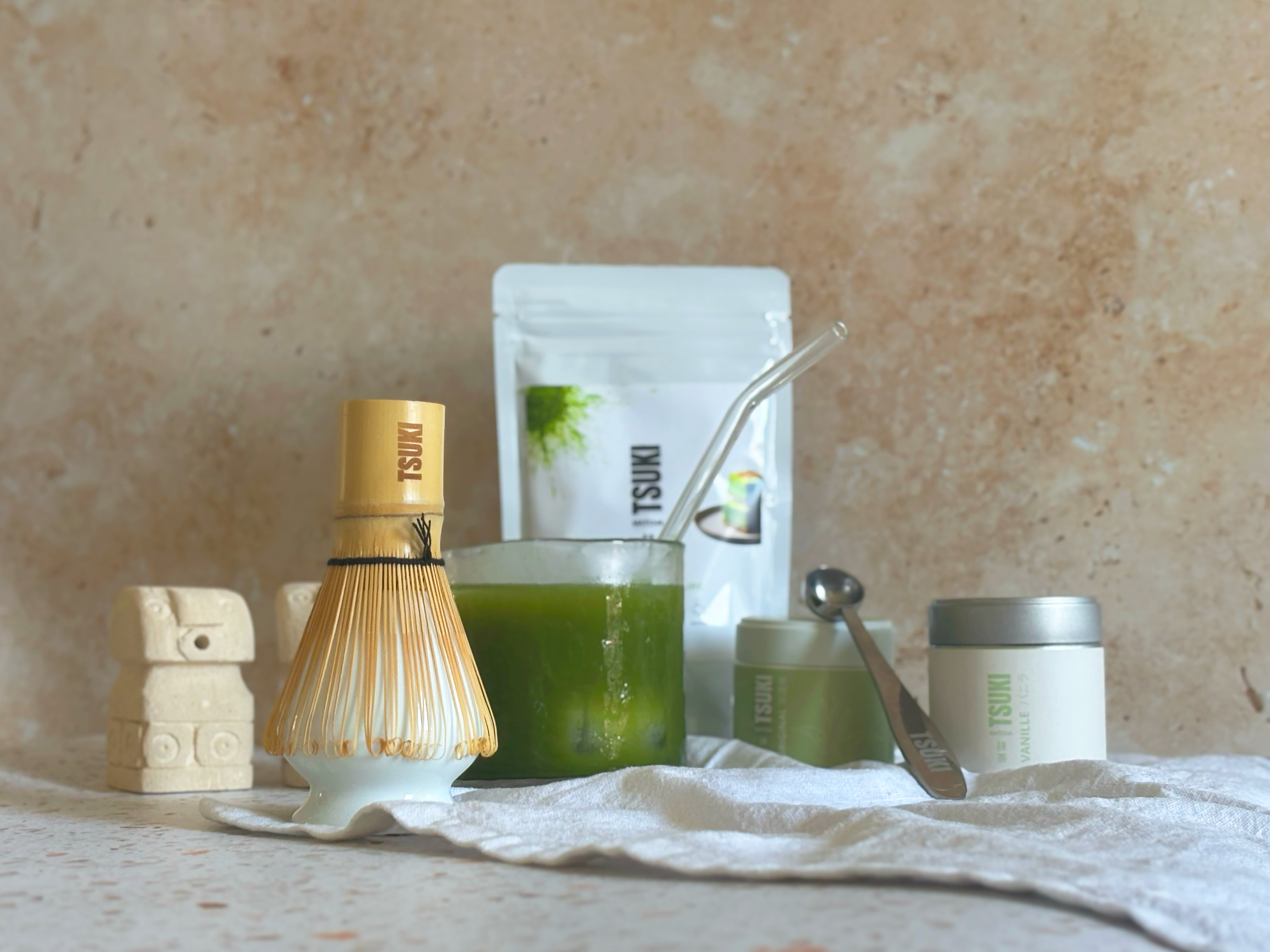

Matcha in Japanese: meaning, writing, and etymology
How do you write "matcha" in Japanese? What do the characters 抹茶 mean? Where does the word come from, how do you pronounce it correctly, and why do these two kanji alone tell the whole story of matcha? A comprehensive look at matcha in Japanese, from etymology to pronunciation.
The word "matcha" has become common worldwide, but few people truly know what it means in Japanese. Where does this word come from? How is it written in kanji? What do the characters that make it up mean? And why does its literal translation alone tell the entire matcha manufacturing process? This article provides a comprehensive overview of matcha in Japanese: etymology, writing, meaning of the kanji, correct pronunciation, and a little cultural journey around this universally recognized word.
How to write "matcha" in Japanese
In Japanese, matcha is most often written with two kanji (Chinese characters adopted by Japanese): 抹茶. This is the official spelling found in texts, packaging, and signs in Japan.
The three writing systems for the word
Like any Japanese word, "matcha" can be written in several ways depending on the system used:
- Kanji : 抹茶 (most common and formal writing)
- Hiragana : まっちゃ (Japanese phonetic writing, rarer for this word)
- Katakana : マッチャ (sometimes used on modern products or for emphasis)
- Romaji : matcha (transcription in the Latin alphabet for non-Japanese speakers)
On the majority of authentic products in Japan, the kanji spelling 抹茶 is used. This is the form with the most meaning, as we will see.
The correct pronunciation
The word is pronounced "mat-cha", with two distinct syllables and a small doubled "t" that should be clearly emphasized. In international phonetic transcription, it is often noted as "maQcha" or "ma'cha" to emphasize this brief stop in the middle of the word. To the ear, it's almost as if you were saying "mate-cha" by blending the two syllables. The usual French pronunciation (a relaxed "mat-cha") remains very acceptable and is perfectly understood in Japan.
The meaning of the kanji 抹茶
This is where the two characters become fascinating: they alone tell the whole specificity of matcha compared to other teas.
First kanji: 抹 (matsu)
The character 抹 literally means "to rub, grind, crush, pulverize". It's the verb that describes the action of reducing something to a fine powder. This kanji is found in other Japanese words related to grinding or erasing. 抹 is the key element that distinguishes matcha from all other Japanese teas: it's what says "ground into powder," the unique characteristic of matcha.
Second kanji: 茶 (cha)
The character 茶 simply means "tea". It is one of the most common kanji in Japanese culture, present in all words related to tea: sencha (煎茶, steeped tea), gyokuro (玉露, shaded elite tea), bancha (番茶, everyday tea), hojicha (焙じ茶, roasted tea), oolong (烏龍茶), and of course cha-no-yu (茶の湯, the tea ceremony).
The literal translation: "ground tea"
Put together, 抹茶 therefore literally means "ground tea" or "powdered tea". It's as simple and as telling as that. The meaning of the word describes exactly the manufacturing process: you take tea (茶), and you grind it (抹). This highly descriptive nomenclature is typical of classical Japanese, which likes to name things by their practical essence.
Why this name is so evocative
The genius of this appellation lies in the fact that it immediately distinguishes matcha from all other Japanese teas, which are brewed with whole leaves. When a Japanese person reads 抹茶, they instantly understand that it refers to the only tea that is consumed entirely ground into powder, whisked with water. The name describes the method, and the method defines the experience. To understand the entire culture surrounding this unique practice, the details on matcha in Japanese culture provide the complete context.
The etymological origin of the word matcha
The term 抹茶 was not born in Japan: it arrived with the technique itself, imported from China in the 12th century.
The arrival of the word with Eisai in 1191
When the Zen Buddhist monk Eisai brought the powdered tea technique from China to Japan in 1191, he also imported the Chinese term "mòchá" (抹茶 pronounced in Chinese during the Song dynasty). The word and the technique traveled together. The Japanese adopted the term, adapting it to their pronunciation, which gave "matcha." For the complete chronology of this historic arrival, the origin of matcha from China to Japan traces the thousand years that followed.
The word takes root in Japan
A fascinating historical paradox: while China gradually abandoned whisked tea starting from the Ming dynasty (14th century) and eventually lost the use of the word itself, Japan preserved and developed the practice. The term 抹茶 thus became, by default, an essentially Japanese word in the eyes of the world, even if it has Chinese roots. This is why everyone today exclusively associates matcha with Japan.
When did the word become universal?
The word "matcha" began appearing in Western languages from the 2000s-2010s, with the explosion in the drink's popularity outside Japan. Before that, it was almost unknown to the general public. Today, "matcha" has entered the dictionaries of many languages without translation, just like "sushi," "wasabi," or "ramen." This is a strong sign of its lasting establishment in global culture.
Japanese words related to matcha
Understanding "matcha" in Japanese also means knowing the words that revolve around it in the vocabulary of the tea ceremony.
Chanoyu (茶の湯): the tea ceremony
Literally "hot water for tea," this is the traditional and most respectful name for the Japanese tea ceremony. A poetic expression that summarizes the ritual to its essential gesture: pouring hot water over matcha. There is also the term "sadō" (茶道, "the way of tea") which refers to the philosophy and practice discipline.
Chasen (茶筅): the bamboo whisk
The famous bamboo whisk used to prepare matcha. Literally "tea bamboo whisk." An essential object without which the characteristic foam of matcha is impossible to obtain.
Chashaku (茶杓): the measuring spoon
The small bamboo spoon used to measure matcha. Literally "tea ladle." Its precise curved shape is designed to measure exactly the right amount of powder.
Chawan (茶碗): the matcha bowl
The wide bowl in which matcha is prepared and drunk. Literally "tea bowl." It is often a unique, sometimes ancient object, which can have great value in the traditional ceremony.
Tencha (碾茶): matcha leaf before grinding
The intermediate stage between the fresh leaf and matcha powder. Literally "milled tea" or "stone tea." It is the raw material used to make matcha, whose quality directly determines the final quality.
Usucha (薄茶) and koicha (濃茶)
Two traditional matcha preparations. Usucha (薄茶, "light matcha") = the common preparation with about 2 g of powder for 60-80 ml of water. Koicha (濃茶, "thick matcha") = the concentrated ceremonial preparation with 4 g for 30-40 ml of water, much more intense.
Definition and meaning: what "matcha" really means
Beyond the etymology, how do we define matcha today?
The technical definition
Matcha is a fine powder of Japanese green tea (Camellia sinensis), obtained from shade-grown leaves that are steamed, dried, stripped of their veins (tencha), then slowly ground with a stone mill. It is prepared by whisking the powder with hot water in a bowl, and is consumed as a whole leaf, without infusion or filtering.
The cultural definition
Beyond being a simple drink, matcha has been associated with Zen Buddhism and the Japanese tea ceremony since the 12th century. It embodies values of mindfulness, harmony, respect, and purity (the four principles of the ceremony codified by Sen no Rikyū). Drinking matcha, in its tradition, is also practicing a moment of presence in the present.
The contemporary definition
In the modern world, matcha has extended far beyond the ceremony: pastries, lattes, cosmetics, dietary supplements, lifestyle. But the word 抹茶 itself always retains its basic meaning: powdered Japanese green tea, stone-ground, to be drunk whisked. This simple definition remains the reference, even in its most modern uses.
Frequently asked questions about matcha in Japanese
How do you write matcha in Japanese?
In Japanese, matcha is most often written in kanji: 抹茶. The first character (抹) means "to grind, to pulverize," and the second (茶) means "tea." Together, they literally mean "ground tea" or "powdered tea." This is the official spelling found on authentic products and in Japanese texts.
What exactly does the word matcha mean?
Matcha (抹茶) literally means "ground tea" in Japanese. The name directly describes the manufacturing process: tea (茶) that has been ground (抹). This simple and descriptive nomenclature distinguishes matcha from all other Japanese teas, which are brewed as whole leaves.
How is matcha pronounced correctly?
The word is pronounced "mat-cha" with two distinct syllables and a small stop on the doubled "t": almost "mate-cha" by blending the two syllables. The usual French pronunciation "mat-cha" is perfectly understood in Japan, even if the Japanese version emphasizes the doubling of the "t" more.
Where does the word matcha etymologically come from?
The term 抹茶 comes from the Chinese "mòchá" during the Song dynasty (10th-13th century). It arrived in Japan in 1191 with the Zen Buddhist monk Eisai, who brought back both the technique and the word. The Japanese adopted it, adapting it to their pronunciation, which resulted in "matcha." Paradoxically, China later lost the use of the word and the technique, making matcha an emblematically Japanese product.
What is the difference between matcha and tencha in Japanese?
Tencha (碾茶) is the intermediate stage before matcha. These are shade-grown tea leaves that are steamed, dried, and stripped of their veins. Tencha becomes matcha (抹茶) once it is ground into fine powder with a stone mill. Tencha = raw material, matcha = final product.
Why are the kanji 抹茶 used and not hiragana?
Because kanji carry meaning. Writing 抹茶 (with the kanji "grind" + "tea") instantly conveys what the product is, whereas the phonetic hiragana writing まっちゃ only tells you how the word is pronounced. Japanese traditionally favors kanji for words that carry cultural or technical meaning, and matcha is clearly one of them.
How do you say "matcha tea" in Japanese?
Simply "matcha" (抹茶). There's no need to add "tea" before it, as the character 茶 in 抹茶 already means "tea." Saying "matcha tea" in English is an unintentional but accepted pleonasm in common usage. In Japanese, you just say 抹茶.
Is the word matcha used outside Japan?
Yes, "matcha" has become an international word since the 2000s-2010s. It has entered the dictionaries of many languages without translation, just like "sushi," "wasabi," or "ramen." This is a sign of matcha's lasting establishment in global culture.
Two kanji, a thousand years of history
Just two characters, 抹 and 茶, summarize the entire identity of a product that spans centuries. This is the elegance of Japanese: naming things by their practical essence, and letting the word tell the process. When you now read 抹茶 on a box or a sign, you will instantly understand what these two signs tell: tea that has been ground, in accordance with a thousand-year-old tradition born in China and perfected in Japan. Matcha is not just a trendy drink. It is a word, a history, a method, and a culture, all in two simple but meaningful kanji.

To discover true 抹茶 in its most authentic tradition, sourced directly from Japanese producers in the Shizuoka and Kagoshima regions (Yabukita cultivar, traditional stone-milled grinding), explore our selection of premium Japanese matcha.


