
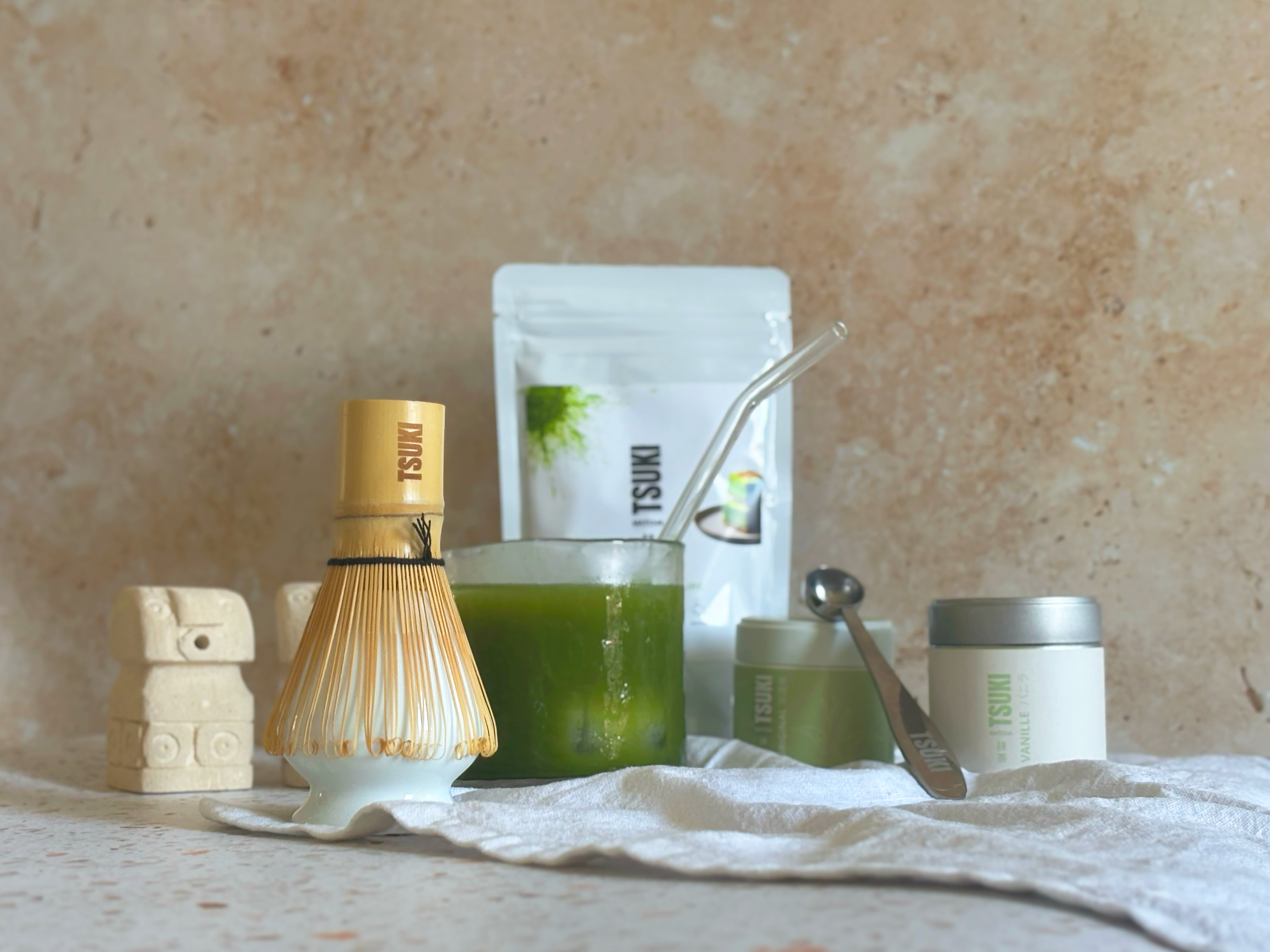

Maté or matcha: what are the differences and which one to choose?
Mate or matcha? These two natural beverages with almost identical names are often confused.
However, everything separates them: their origin, the plant, the taste, the preparation, and even how the energy diffuses in the body.
This guide compares mate and matcha based on all the criteria that matter to help you make your choice.
Origins and Traditions
The resemblance between "mate" and "matcha" is a pure linguistic coincidence. The two words come from very different languages and cultures.
Matcha: Japan's Powdered Green Tea
Matcha means "ground tea" in Japanese. It comes from Camellia sinensis, the same plant as classic green tea, but cultivated and processed uniquely. The tea plants are shaded three to four weeks before harvest to stimulate chlorophyll and L-theanine production. The leaves are then processed into tencha, then ground on stone mills to obtain an ultra-fine powder.

Matcha originated in Japan in the 12th century, introduced by the Buddhist monk Eisai from China. It became the heart of the Japanese tea ceremony (chanoyu), a ritual combining meditation, aesthetics, and tasting. Today, it is consumed both traditionally and in lattes, smoothies, or pastries.
Mate: The Convivial Infusion of South America
Mate (yerba mate) comes from Ilex paraguariensis, a shrub in the holly family, native to South America. The word "mati" comes from Quechua and refers to the gourd from which the drink is consumed.
Consumed for centuries by the Guaraní people in Paraguay, mate has become the national drink in Argentina, Uruguay, and southern Brazil. Unlike matcha, mate is shared: the gourd and bombilla (filter straw) are passed around in a circle. It is a symbol of conviviality and friendship.

Where matcha is associated with calm and meditation, mate is linked to sharing and collective energy. Two very different philosophies around the same promise: a natural and stimulating drink.
Composition and Benefits
Both mate and matcha are rich in nutrients, antioxidants, and caffeine. But their composition differs in important ways.
Antioxidants
Matcha is one of the richest antioxidant foods available. Its concentration of catechins, particularly EGCG (epigallocatechin gallate), is exceptional. EGCG is known for its action on metabolism, cellular protection, and immune system support. To learn more, see our detailed article on the benefits of matcha.

Mate is also very rich in antioxidants, but of a different type. Its main antioxidant is chlorogenic acid, also found in coffee. This acid acts on blood pressure, cholesterol, and glucose regulation.
Both drinks are therefore excellent for health, but with distinct antioxidant mechanisms. Matcha stands out for its unique catechins (absent in mate), while mate provides more theobromine (the feel-good molecule found in chocolate).
Vitamins and Minerals
Mate is rich in B vitamins, potassium, and magnesium. Matcha provides vitamin C, vitamin E, zinc, and a significant amount of chlorophyll thanks to the shading of the leaves.
These two drinks have beneficial effects on metabolism.
Both drinks are low in calories and naturally sugar-free.
Effect on Weight
Both drinks are known to support weight management. Matcha stimulates thermogenesis (fat burning) thanks to EGCG. Mate promotes satiety and increases energy expenditure. To delve deeper into this topic, read our article matcha and weight loss.
Taste and Preparation
The Taste of Matcha
Quality matcha has an umami, smooth, and vegetal taste, with very little bitterness. The notes recall fresh grass, sometimes seaweed or green vegetables. A ceremonial grade matcha like TSUKI Original matcha offers a balanced, round, and accessible profile, even for those new to matcha.
The Taste of Mate
Mate has a more intense and bitter taste. Its notes are woody, earthy, sometimes smoky depending on the drying method. Green mate (unroasted) is milder and herbaceous but generally more astringent than matcha. It is a drink with a more assertive character that can surprise unaccustomed palates.
Preparation
Matcha is prepared by whisking 1.5 to 2g of powder in 70 to 80ml of hot water (70-75°C) with a chasen (bamboo whisk). The result is a foamy and creamy drink. Matcha can also be prepared as a latte with milk, in a smoothie, or iced.
Mate is prepared by infusion. Two-thirds of a gourd are filled with yerba mate leaves, the bombilla is inserted, then hot water (70-80°C) is gradually poured in. The same leaves can be reinfused several times. Mate is also drunk iced (tereré).
The fundamental difference: with matcha, you consume the entire leaf in powder form. With mate, you infuse the leaves and only drink the infusion water. This is why matcha concentrates more nutrients per cup.

Caffeine and Energy
This is one of the most important criteria for those looking for a coffee alternative.
Mate contains approximately 70 to 90 mg of caffeine per cup. This is close to an espresso. The effect is fast, with a real energy boost. The theobromine present in mate slightly reduces nervousness, but the effect remains more "frontal" than that of matcha.
Matcha contains approximately 30 to 50 mg of caffeine per cup, but the energy experience is very different. L-theanine, an amino acid naturally present in large quantities in matcha, slows down caffeine absorption and promotes a state of calm alertness. No sudden peak, no crash. Energy diffuses gradually over 4 to 8 hours.
It is this caffeine + L-theanine combination that makes matcha unique. Mate does not contain it (or in very small quantities).
For a detailed comparison with coffee, discover our article matcha vs coffee.
Complete Comparative Table: Mate vs Matcha
| Criterion | Matcha | Mate |
|---|---|---|
| Origin | Japan | South America (Argentina, Paraguay, Brazil) |
| Plant | Camellia sinensis (green tea) | Ilex paraguariensis (holly) |
| Form | Fine powder (whole leaf) | Dried leaves (infusion) |
| Caffeine per cup | 30 to 50 mg | 70 to 90 mg |
| L-theanine | Yes (in large quantities) | No (or traces) |
| Type of energy | Smooth, progressive, 4 to 8 h | Rapid, stimulating, 2 to 4 h |
| Main antioxidant | EGCG (catechins) | Chlorogenic acid |
| Taste | Umami, sweet, vegetal | Woody, earthy, bitter |
| Preparation | Whisked in water (powder) | Infused in water (leaves) |
| Leaf consumption | Yes (whole, in powder) | No (infusion only) |
| Versatility | Drinks, lattes, cooking, baking | Hot or cold drink |
| Associated culture | Meditation, calm, individual ritual | Sharing, conviviality, collective energy |
Verdict: When to choose matcha and when to choose mate?
Mate and matcha are not in competition. They are two complementary drinks that meet different needs.
Choose matcha if you are looking for gentle, sustained energy without nervousness. The caffeine + L-theanine combination is unique to matcha and offers a state of calm concentration ideal for work, creativity, or meditation. Matcha is also the logical choice if you want to take full advantage of catechins (EGCG) and consume the entire leaf with all its nutrients.
Choose mate if you need a quick and straightforward boost, similar to the effect of coffee but with fewer side effects. Mate is well suited for athletes who want a kick before exercise, or for people who enjoy the more intense, earthy taste of robust infusions.
What if you're undecided? Try both. There's nothing to stop you from alternating: matcha in the morning for serene concentration, mate in the early afternoon for an energy boost. Many people incorporate both into their routine.
If you want to discover matcha, start with a ceremonial grade matcha with a smooth, accessible taste. TSUKI Original matcha is grown in Japan (Yabukita cultivar), stone-ground, and offers a balanced, bitterness-free profile. For palates that prefer a gourmet touch, Vanilla matcha combines the richness of ceremonial matcha with biscuity notes of natural vanilla.
FAQ: Mate and Matcha
Do mate and matcha come from the same plant?
No. Matcha comes from Camellia sinensis, the green tea plant, cultivated in Japan. Mate comes from Ilex paraguariensis, a shrub in the holly family, native to South America. They are two completely different plants.
Which contains more caffeine?
Mate contains more caffeine per cup (70 to 90 mg compared to 30 to 50 mg for matcha). But matcha offers a more gradual release of caffeine thanks to L-theanine, which provides a more stable and longer-lasting energy without nervousness.
Can you mix mate and matcha?
It's technically possible, but the two drinks have very different flavor profiles. Mixing them doesn't offer any particular benefit and risks resulting in a muddled taste. It's better to consume them separately, at different times of the day.
Is mate healthier than matcha?
Both drinks have excellent but distinct benefit profiles. Matcha stands out for its richness in catechins (EGCG), L-theanine, and chlorophyll. Mate provides more theobromine, B vitamins, and minerals like potassium. Neither is "better" than the other. The choice depends on what you are looking for.
Does mate have the same effect on concentration as matcha?
Both improve concentration thanks to caffeine. But matcha offers a unique advantage: L-theanine promotes a state of calm alertness, without agitation. Mate provides a more direct and "physical" boost, but without the mental serenity unique to matcha.
Which is easier to prepare?
Matcha can be prepared in less than 2 minutes with a whisk and hot water. Mate requires a gourd, a bombilla, and a bit of practice to master the infusion technique. Both are simple once you get the hang of it, but matcha is probably faster for daily use, especially as a latte.
Want to try matcha? Discover our ceremonial grade matchas and experience the gentle, focused, and sustained energy.


