
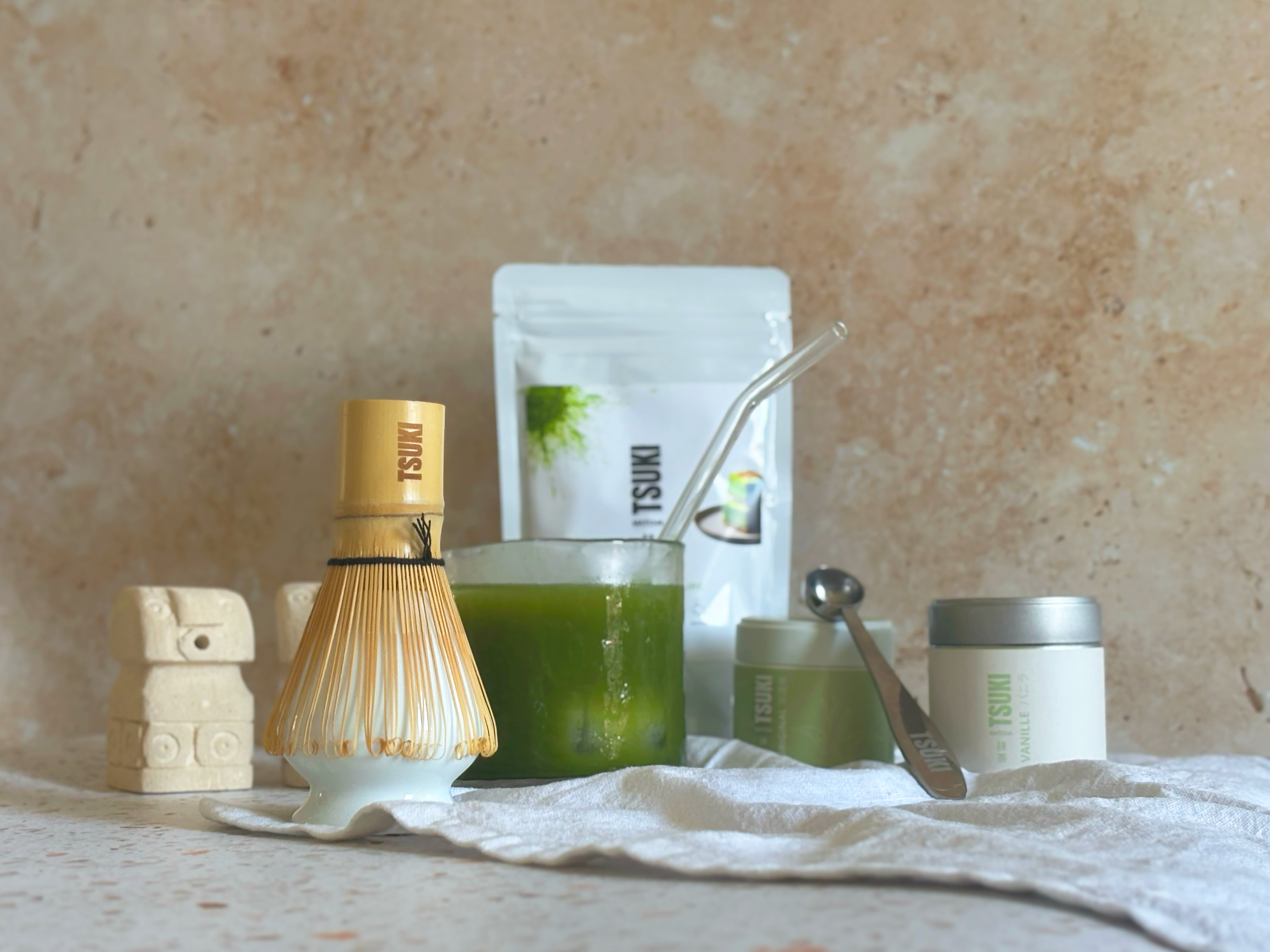

Where to buy matcha in France? Complete guide
Do you want to buy matcha but don't know where to find it? Supermarkets, organic stores, specialized tea shops, or online stores: there's no shortage of options in France.
The problem is that quality varies enormously from one matcha to another, from one site to another, from one store to another.
This guide reviews each option to help you find real quality matcha, without unpleasant surprises.
In supermarkets (Carrefour, Auchan, Leclerc)
It's often the first reflex: checking the tea aisle at your usual supermarket. And indeed, you can find "matcha" in supermarkets. But not always what you're hoping for.

What you'll most often find are tea bags flavored with matcha (like Pukka, Lipton). These products contain between 2% and 5% matcha, blended with classic green tea. This is not matcha; it's green tea with a touch of matcha. The taste, color, and benefits have nothing to do with real powdered matcha.
Some stores also offer powdered matcha in boxes (brands like Aromandise or Jolivia). These products are generally culinary grade, suitable for baking or smoothies, but rarely fine and smooth enough to be drunk as pure matcha or a quality latte. The price per gram is decent, but the origin is sometimes vague (China rather than Japan).
Advantages
Accessible everywhere in France. No delivery fees. Allows you to discover matcha on a budget.
Limitations
Very limited choice. Rarely ceremonial quality. Many flavored or blended products that are not real matcha. Little traceability on origin and cultivar.
In organic stores (Biocoop, Naturalia, La Vie Claire)
Organic stores offer a better guarantee on one point: organic certification. You will find organic matcha powder there, often from brands like Aromandise, Kusmi Tea, or private labels.

The quality is generally a step above supermarkets. The products are organic certified, pesticide-free, and the origin is generally indicated (Japan, sometimes China). You will also find ready-to-use preparations (matcha latte powder with oats and added sugar).
The point of vigilance concerns blended preparations. A powdered "matcha latte" sold in an organic store may contain only 5% to 20% matcha, with the rest being sugar, vegetable milk powder, and flavorings. Always read the ingredient list. Good matcha contains only one ingredient: matcha. To better understand these distinctions, our article organic vs. conventional matcha: what are the differences will help you see things more clearly.
Advantages
Reliable organic certification. Better quality than in supermarkets. Possible in-store advice.
Limitations
Often high price for culinary matcha. Little ceremonial grade matcha. Many blended preparations (sugar, powdered milk). Limited choice to a few brands.
In specialized boutiques (Palais des Thés, Mariage Frères, Japanese stores)
Specialized tea shops are the best physical channel to find quality matcha. Brands like Palais des Thés, Mariage Frères, Jugetsudo, or Japanese grocery stores offer ceremonial-grade matchas, with traceability on the region of origin and sometimes the cultivar.

The shopping experience is also richer. You can see the color of the powder, smell the matcha, and sometimes taste it on site. Sales assistants are generally trained and can guide you towards the right product according to your use (drink, latte, cooking).
The main drawback is accessibility. These stores are concentrated in large cities, mainly Paris. If you live outside a major city, this channel is not a daily option.
Advantages
Ceremonial grade matcha available. Traceability (origin, cultivar). Personalized advice. Possibility to see and smell the product.
Limitations
Stores concentrated in large cities. High prices (rent, intermediaries). Less variety than online.
Online: the best quality-choice ratio
Online shopping is currently the most suitable channel for finding quality matcha in France, no matter where you live. Brands specializing in matcha mainly sell on their own websites, with complete transparency on origin, grade, cultivar, and production method.

The advantages are numerous. You gain access to carefully selected ceremonial-grade matchas, often at a lower price than physical stores (no rent, no intermediaries). Customer reviews allow you to validate the quality before purchasing. And delivery is fast, often within 48 hours in France.
The only drawback is that you cannot taste before buying. But good brands compensate with total transparency about their products: photos, detailed descriptions, information on the terroir and the manufacturing process. Our article buying matcha online or in store details the advantages and disadvantages of each approach.

At TSUKI, our ceremonial grade matchas are cultivated in Japan (Yabukita cultivar, Shizuoka and Kagoshima regions), stone-ground, and shipped within 48 hours from France.
Our kits are also highly appreciated and make an ideal gift for any occasion.

More than 1,000 customers trust us and 99.9% are satisfied with the quality. Free delivery from €29 to a relay point.
Advantages
Best choice for quality matcha. Often more competitive prices. Total transparency (origin, grade, cultivar). Fast delivery throughout France. Customer reviews available.
Limitations
Impossible to taste before buying. Possible shipping costs (often free above a certain threshold). Free shipping from €50 purchase. And -10% discount with code WELCOME10.
Comparative table of purchase channels
| Criterion | Supermarket | Organic store | Specialty store | Online (specialized brand) |
|---|---|---|---|---|
| Grade available | Culinary / blended | Culinary / premium | Ceremonial / premium | Ceremonial / premium / culinary |
| Traceability | Low | Medium | Good | Excellent |
| Price per gram | € | €€ | €€€ | €€ (best value) |
| Product choice | Very limited | Limited | Good | Wide |
| Geographical accessibility | Everywhere in France | Medium and large cities | Large cities only | Everywhere (delivery) |
| Personalized advice | No | Basic | Yes | Via chat, email, FAQ |
| Verified customer reviews | No | No | No | Yes |
How to avoid pitfalls when buying matcha
A few simple habits will save you from disappointments.
Check the ingredient list. Authentic matcha contains only one ingredient: matcha (or "green tea powder"). If you see sugar, powdered milk, flavorings, or other teas in the composition, it is not pure matcha.
Look at the origin. Japanese matcha remains the global benchmark. The regions of Shizuoka, Kagoshima, Uji, and Nishio are the most recognized. Matcha produced in China can be of decent quality, but the expertise and standards are not the same.

Our matcha producers in Shizuoka, Japan.
Identify the grade. The distinction between ceremonial grade and culinary grade is essential. Ceremonial grade is smooth, fine, and suitable for beverages. Culinary grade is more robust and designed for cooking. Buying culinary grade to drink as a latte will result in a bitter and disappointing experience.
Beware of excessively low prices. Ceremonial grade matcha, stone-ground in Japan, cannot cost €5 for 100g. If it does, there's a compromise somewhere (origin, leaf quality, grinding method). Good matcha has a high production cost that is reflected in the price.
Observe the color in photos. Good matcha is a vibrant, bright green. Yellowish or dull matcha is likely of inferior quality or oxidized.

FAQ: Buying matcha in France
Can you find good matcha in supermarkets?
It's very rare. Supermarkets mainly offer green teas flavored with matcha (2 to 5% matcha) or culinary grade powder. For ceremonial grade matcha suitable for lattes and tasting, specialized boutiques or online brands are much better options.
What budget should I plan for good matcha?
A quality ceremonial-grade matcha costs between €25 and €40 for 30g, which makes about 15 to 20 cups, or €1.30 to €2 per cup. This is comparable to the price of a coffee at a bakery, but with incomparable benefits. Culinary matcha is cheaper (€15 to €25 for 30g) but is not suitable for beverages.
Is matcha sold on Amazon reliable?
Amazon offers a very wide range of matchas, from the best to the worst. The difficulty is in sorting them out. Prioritize brands that clearly display Japanese origin, grade, and cultivar. Customer reviews are helpful, but make sure they concern taste and quality, not just delivery. Buying directly from a specialized brand's website generally offers more guarantees and better service.
How do I know if my matcha is truly Japanese?
Look for the country of origin on the packaging. The best brands also specify the region (Shizuoka, Kagoshima, Uji) and sometimes the cultivar (Yabukita, Okumidori, etc.). The absence of this information is often a sign of matcha of uncertain origin.
Do I have to buy organic matcha?
Organic certification guarantees the absence of pesticides, but it's not the only criterion. An organic culinary-grade matcha will always be inferior in taste to a well-produced conventional ceremonial-grade matcha. The ideal is to combine both: an organic AND ceremonial-grade matcha. Our article on organic vs. conventional matcha details the nuances.
Does TSUKI Matcha deliver everywhere in France?
Yes. We deliver to mainland France, overseas departments and territories, Europe, and internationally. Delivery to a relay point is free for orders over €50. Shipping is done within 48 hours from France with a tracking number.

Ready to order your matcha? Discover our ceremonial grade matchas, cultivated in Japan, delivered in 48 hours everywhere in France.


