
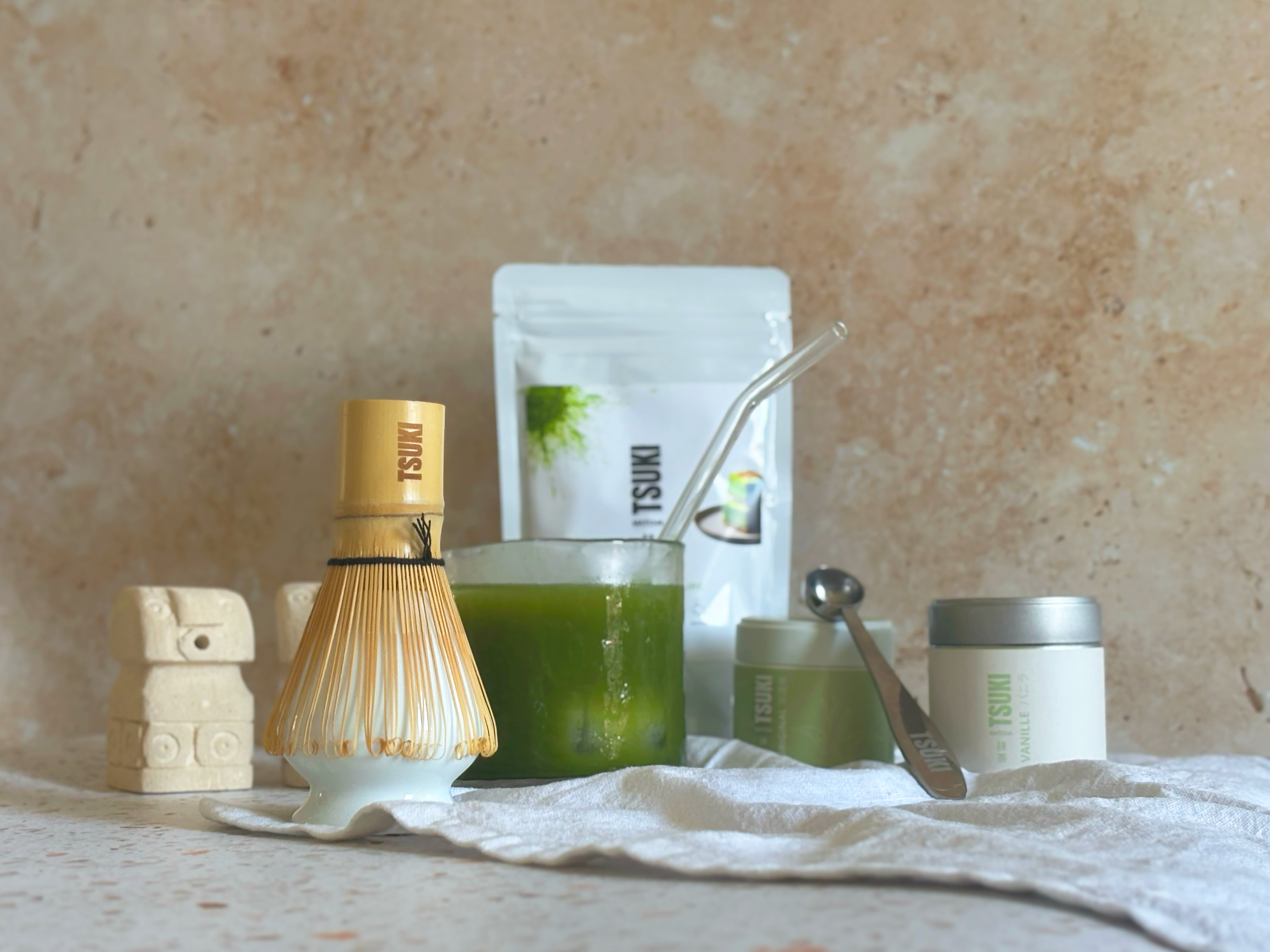

Matcha on Amazon: How to choose wisely and avoid pitfalls
Amazon lists hundreds of matcha products at all price points. Good deals, real brands, counterfeits, oxidized powders: the market is opaque and product descriptions are misleading.
Here's how to quickly sort the legitimate from the dubious, and buy matcha that truly delivers on its promises.
Why Amazon is Tricky for Matcha
Amazon has become the primary entry point for buying matcha online. The selection is huge, delivery is fast, and returns are easy. These qualities also make the platform particularly tricky to navigate when it comes to a product as sensitive as Japanese green tea powder.
Three problems consistently arise. Multiple sellers behind the same product listing, with stock from various sources. Opacity regarding storage conditions before shipping, even though matcha oxidizes quickly when exposed to light and heat. Unknown brands mimicking the packaging of established names, sometimes with Japanese-inspired visuals but with Chinese or South Asian origins.
Add to this a real legal issue: the term "matcha" is only protected in Japan. Everywhere else, any green tea ground into powder can legally be sold under this name. As a result, you can find "matcha" on Amazon that lacks the shading, cultivar, or stone-grinding that define true premium Japanese matcha.

The good news: with a few simple criteria, you can eliminate 80% of dubious products in under two minutes.
The 7 Criteria for Choosing Matcha on Amazon
Here's the checklist to apply before adding to your cart.
1. Precise Origin, Not Just "Japan"
The product description or packaging should name a region: Shizuoka, Kagoshima, Uji, Nishio, Yame. A simple "origin Japan" is not sufficient, and "origin Asia" is a red flag. Serious producers highlight their terroir.
2. Clearly Stated Grade
Ceremonial for pure drinking, culinary for lattes and baking. Matcha that doesn't specify its grade raises doubts. The difference between ceremonial and culinary matcha completely changes the result in terms of taste.
3. Cultivar Mentioned
Yabukita, Okumidori, Samidori, Asahi. A named cultivar proves the seller has control over their supply chain. Its absence isn't a deal-breaker, but its presence is always a good sign.
4. Opaque and Resealable Packaging
A hermetic metal tin or a double-sealed aluminum pouch. Avoid transparent glass jars, thin plastic bags, and especially any packaging larger than 100 grams for domestic use. An opened tin should ideally be consumed within six to eight weeks.
5. Color Visible in Photos
True ceremonial matcha is jade green, almost fluorescent.

If the product photos show an olive green, brown, or yellowish powder, move on: it's oxidized matcha, late harvest, or simply ground green tea.
6. Identified Seller
Check who is shipping. "Sold by [official brand], shipped by Amazon" is the ideal scenario. "Sold by XYZ-Shop-Global" with an empty seller profile and a few dozen reviews is a scenario to avoid. For a known brand, always verify that you are buying from the official account.
7. Relevant Customer Reviews
An overall rating of 4.5 stars isn't enough. Filter by "recent reviews" and read some three-star reviews: this is where real problems emerge (bland powder, disappointing color, damaged packaging, difference from visuals).
Be wary of listings with 2000 reviews, 1800 of which are in English for a product sold in France: this is often a sign of ASIN recycling.
The Most Common Pitfalls on Amazon
Several patterns consistently appear in poor purchasing experiences.
"Premium" matcha that's too cheap. Serious Japanese ceremonial matcha rarely starts below €0.80 per gram. A "premium ceremonial organic Japanese matcha" at €12 for 100g is almost always a re-packaged Chinese ground green tea. It's not illegal, but it has nothing to do with the expected product.
Flashy packaging, empty label. Pretty box, Japanese calligraphy, Mount Fuji in the background, and no concrete information on the back. If the description doesn't specify the region, cultivar, or harvest date, there's not much behind the design.
The "complete matcha kit" at a bargain price. These whisk-bowl-powder packs for €19.99 seem practical. In practice, the powder is at the end of its shelf life, the treated bamboo whisk has brittle bristles, and the bowl is just a ramekin.

A serious starter kit costs more, but lasts.
Powder with good taste but dull color. Typical of decent but old matcha. Transportation, marketplace storage, and rotation time have taken their toll. The taste remains honorable, but the color, foam, and antioxidants have been lost along the way.
Imitations of established brands. Several Japanese or French brands see their packaging copied by third-party sellers. The packaging looks similar, the product does not. Always buy through the brand's official store when available.
How to Spot Reliable Brands in 30 Seconds
Before clicking buy, three quick checks are enough.
Look for the brand's official website outside of Amazon. A real brand has a website, legal information, an address, and contact details. If the brand only exists on Amazon, it's rarely a good sign.
Verify consistency between the Amazon page and the brand's website. Same range, same visuals, same reference prices. A significant discrepancy often indicates an unauthorized third-party seller.
Check the review history. A serious brand has reviews spanning several years. A surge of reviews over two months, followed by silence, is typical of a marketing push with no substance behind it.
Buying Directly vs. Buying on Amazon
Amazon and direct purchases from the brand's website don't exactly meet the same needs. Here are the main trade-offs.
| Criterion | Amazon | Brand Website |
|---|---|---|
| Delivery | 24-48h with Prime | 2-4 days on average |
| Range of Products | Limited selection, often best-sellers | Complete range (matcha, accessories, kits) |
| Stock Freshness | Variable, warehouse rotation | Rotation managed by the brand |
| Customer Service | Amazon CS (product return) | Dedicated team, tasting advice |
| Price | Often similar, sometimes promotions | Official price, loyalty offers and bundles |
| Counterfeit Risk | Real on marketplace, none if "sold by brand" | None |
In practice, if you just want to replenish your stock of a product you already know, Amazon is perfect, provided you buy from the brand's official account. To discover a brand, test several grades, or assemble a coherent kit, going through the direct website is safer, more economical in the long run, and provides access to an objective comparison of the best matchas before choosing.
The trade-off is similar for the choice between online and physical stores, or for comparing with matchas sold in supermarkets: real quality depends on traceability and rotation, not the channel.
TSUKI Matcha on Amazon: What You'll Find
TSUKI is sold directly on tsukimatcha.com and also available on Amazon for customers who prefer that platform. TSUKI Vanilla matcha is available on Amazon under the brand's official account, with the same powder as that shipped from the website, sourced from Shizuoka and Kagoshima, Yabukita cultivar, stone-ground.

The complete range (Original matcha, Vanilla matcha, Culinary matcha, accessories, and kits) remains wider on tsukimatcha.com, with preparation recommendations, storage tips, and detailed sheets by cultivar and origin. Regarding the ideal format between sachet and tin, the 30g metal tin remains the safest compromise for preserving aromas between each opening.
Matcha Accessories on Amazon: The Real Criteria
Many Amazon purchases also concern accessories: chasen whisk, measuring scoop, bowl. Here are some useful benchmarks.
For the whisk, look for "80 to 120 prongs" depending on use. Below 80 prongs, foam is difficult to achieve. Prefer untreated bamboo, with no visible glue on the base. A serious chasen whisk costs around €15 to €25.
For the measuring spoon (chashaku), smooth bamboo is sufficient. Beware of kits where the spoon is made of green plastic.
For the matcha bowl (chawan), a sufficiently wide base (11 to 13 cm) is necessary for proper whisking in a W-shape. Mini-bowls of 8 cm sold as "matcha bowls" are actually mislabeled sake cups.
The criteria for good matcha and good equipment converge on the same principle: transparency regarding origin and materials always outweighs the design of the listing.
FAQ: Buying Matcha on Amazon
Can you find good matcha on Amazon?
Yes, provided you buy from the official account of an identified brand, with a listing that specifies origin, cultivar, and grade. On average, only 15% to 20% of the products available on Amazon meet these criteria.
What is the difference compared to matcha bought directly?
The product is identical if it comes from the official account. The difference lies in the available range (more restricted on Amazon), stock freshness (better managed directly), and advice about the product (preparation, storage, grade selection).
How to spot counterfeit matcha?
Three signs: a significantly lower price than the brand's website, an unknown third-party seller, and listing visuals that don't match those on the official website. When in doubt, order directly from the brand's website.
Are Amazon matcha kits a good idea?
Rarely. Most entry-level kits combine mediocre powder with a fragile whisk and a disproportionate bowl. It's better to buy powder and accessories separately, or opt for a kit offered by a specialized brand.
How much should I order to start?
A 30 to 50g size is ideal for a first purchase. This corresponds to about 30 to 50 bowls depending on the dosage, or one to two months of regular consumption. Beyond that, the risk of oxidation before consumption increases.
Does Amazon guarantee matcha freshness?
Not specifically. Matcha does not receive special handling in warehouses. If you want a guarantee on the grinding date and storage conditions, ordering directly from the brand remains the most reliable option.
In Summary
Amazon can be a good channel for buying matcha, provided you know how to read a product listing. Precise origin, stated grade, mentioned cultivar, opaque packaging, clear color in photos, official seller, recent reviews: with this seven-point checklist, you can quickly eliminate dubious products.
To discover a brand, compare grades, or benefit from the full range, going through the direct website offers more. To replenish a product you already know, Amazon does the job very well as long as you buy from the official account.
Want to start with matcha whose origin, cultivar, and process are clearly documented? Discover the TSUKI premium matcha selection, cultivated in Shizuoka and Kagoshima, stone-ground, and shipped directly from France.


