
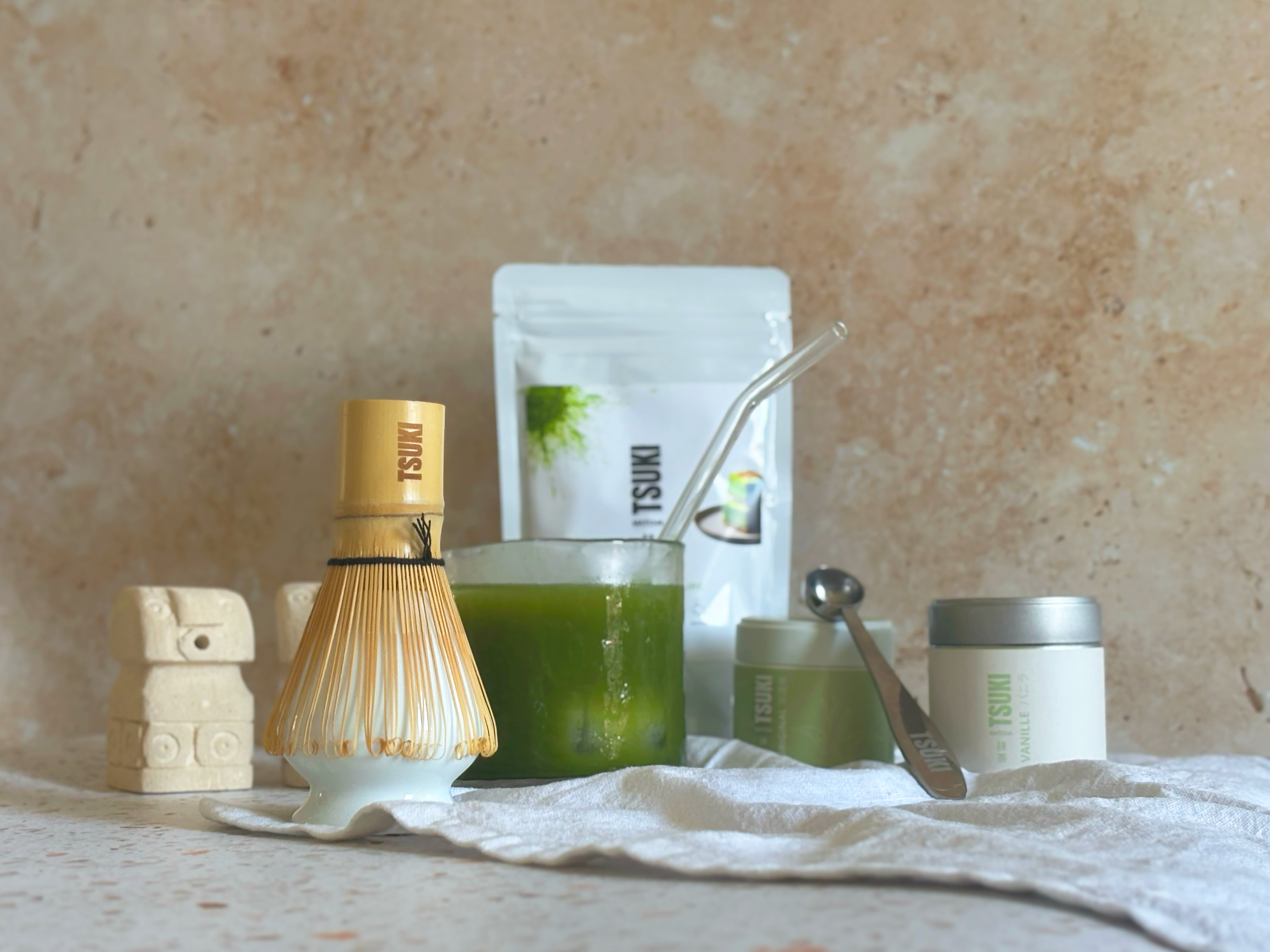

What is matcha? Everything you need to know in 5 minutes
You've seen green lattes on Instagram, spotted the word "matcha" on cafe menus, or heard about its benefits from a friend.
But what exactly is matcha?
This guide explains the essentials in 5 minutes: what it is, how it's made, what makes it unique, what it's used for, and how to choose it.
Simple definition: what is matcha?
Matcha (抹茶) means "ground tea" in Japanese. It is a very fine powder obtained by grinding Japanese green tea leaves. These leaves come from the same plant as all green teas (Camellia sinensis), but they are cultivated and processed in a unique way that gives matcha its exceptional properties.
The big difference with a classic green tea? When you drink green tea, you steep the leaves in water and then remove them. You only consume a part of what the leaf contains. With matcha, you consume the entire leaf, ground into powder and mixed directly into the water. The result: you ingest 100% of the nutrients, antioxidants, and amino acids present in the leaf.

This particularity is what makes matcha a concentrate of benefits. A cup of matcha contains up to 137 times more catechins (green tea antioxidants) than a cup of classic brewed green tea.
How is it produced?
Matcha production follows an ancient four-step process. Each step influences the quality, taste, and color of the final powder.
Shading
Three to four weeks before harvest, tea plants are covered with opaque nets that block about 90% of sunlight. Deprived of light, the leaves compensate by producing more chlorophyll (which gives them their intense green color) and L-theanine (an amino acid responsible for the umami taste and the calming effect of matcha). This step distinguishes matcha from all other green teas.

Harvest
Only the young top leaves are picked, often by hand for the best grades. These leaves are the tenderest, richest in nutrients, and least bitter. Major producing regions like Shizuoka, Uji, and Kagoshima harvest primarily in spring, during the first flush, which yields the finest matcha.

Processing into tencha
The fresh leaves are steamed to stop oxidation and preserve their vibrant color. They are then dried, and stems and veins are removed. What remains, the tender core of the leaf, is called tencha. This is the exclusive raw material for matcha.

Stone grinding
The tencha is slowly ground between two granite millstones. This process is deliberately slow (about 30 g per hour) to avoid heating that would alter the aromas. The result is an extremely fine powder, between 5 and 10 microns. It is this fineness that gives matcha its silky texture and its ability to suspend in water rather than settling at the bottom.

Matcha vs. classic green tea: the real differences
Matcha and green tea come from the same plant, but the experience is radically different.
Classic green tea (sencha, bancha, etc.) grows in the sun. Its leaves are steeped in hot water and then removed. You drink the infusion, not the leaves. The taste is light, sometimes astringent. The benefits are real but limited to what the water has extracted from the leaves.
Matcha is shade-grown. Its leaves are ground into powder and consumed whole. Nothing is filtered. The taste is richer, deeper, with characteristic umami notes. The benefits are concentrated because you ingest the entire leaf.

In terms of nutrients, one cup of matcha is equivalent to about 10 cups of brewed green tea. This concentration makes matcha a true superfood, far beyond a simple tea.
Benefits in brief
Matcha is one of the richest antioxidant foods known. Its health benefits are numerous and documented by scientific research.
Energy without jitters. Matcha contains caffeine (30 to 50 mg per cup, compared to 80 to 100 mg for coffee). But its caffeine is associated with L-theanine, an amino acid that slows down its absorption. The result is calm and sustained concentration, without the sudden peak or crash of coffee.
Cell protection. Matcha catechins, especially EGCG, neutralize free radicals responsible for cellular aging. This is why matcha is also associated with skin health and the prevention of oxidative stress.
Metabolic support. EGCG helps stimulate thermogenesis and fat oxidation. Matcha can thus support an active metabolism as part of a healthy lifestyle.
Calming effect. L-theanine promotes the production of alpha waves in the brain, associated with a state of relaxed alertness. This is why Buddhist monks used matcha to accompany their meditation nearly a thousand years ago.
How to prepare it
Preparing matcha is simpler than it seems. No machine needed. Two minutes are enough.
The traditional method. Sieve 1.5 to 2 g of matcha (one level teaspoon) into a bowl. Pour 70 to 80 ml of hot water at 70-75 °C (never boiling, water that is too hot makes matcha bitter).
Whisk vigorously with a chasen (bamboo whisk) in M or W motions for 15 to 20 seconds, until you get a fine, creamy foam. A matcha bowl makes the gesture easier thanks to its rounded shape, and a measuring spoon allows you to measure the right quantity every time.

In matcha latte. Prepare your matcha shot as above, then add 200 ml of hot or cold milk (oat, almond, coconut, or whole milk). This is the most popular version in coffee shops and the most accessible for beginners.

As an iced version. Whisk the matcha in a little hot water, then pour over a large glass of ice and top with cold milk. Perfect for summer.
Matcha is also used in cooking: pastries, smoothies, ice cream, sauces. Its versatility is one of its strengths. The history of matcha is intimately linked to its culinary use in Japan, far beyond a simple drink.
How to choose your matcha well
Not all matchas are created equal. Here are the essential criteria for making the right choice.
Origin
Opt for matcha grown in Japan. The regions of Shizuoka, Kagoshima, Uji, and Nishio are renowned for the quality of their terroir. Authentic Japanese matcha benefits from centuries of know-how that other producing countries cannot yet match.
Grade
Ceremonial grade matcha is made from the youngest and finest leaves. Its taste is smooth, without bitterness, with umami notes. It is the ideal grade for drinks (pure matcha, latte, iced). Culinary matcha, made from more mature leaves, has a more robust and bitter taste. It is designed to withstand cooking in recipes.
Color
A good matcha has a bright, vibrant, almost neon green color. A yellowish or dull matcha is likely of poor quality, oxidized, or made from unshaded leaves.
Fineness
The powder should be extremely fine and silky to the touch. If it is grainy, the grinding was not done with stone mills or was done too quickly.
At TSUKI, our ceremonial grade matchas are grown in Japan (Yabukita cultivar, Shizuoka and Kagoshima regions), shaded before harvest, and stone-ground according to the traditional method. Over 1,000 customers trust us, and 99.9% are satisfied with the quality of our teas.
FAQ: everything about matcha
What exactly is matcha?
Matcha is a Japanese green tea powder obtained by grinding shade-grown tea leaves. Unlike classic green tea that is steeped, matcha is consumed whole: the powder is whisked in hot water and ingested with all its nutrients.
What is matcha used for?
Matcha is primarily used as a daily beverage, hot or cold. It can be prepared as traditional matcha (powder + water), as a latte (with milk), in a smoothie, or as an iced version. It is also used in cooking: pastries, ice cream, desserts, sauces. Its benefits also make it a wellness ally for energy, concentration, and skin health.
Is matcha better than coffee?
Matcha and coffee have very different profiles. Coffee gives a quick boost but often followed by a crash. Matcha offers a gentler and longer-lasting energy thanks to L-theanine, which moderates the effect of caffeine. Many people switch from coffee to matcha for this reason.
Does matcha have caffeine?
Yes. A cup of matcha contains about 30 to 50 mg of caffeine, about half of an espresso. But the effect is very different thanks to L-theanine: the energy is released gradually over 4 to 8 hours, without jitters or a sudden peak.
Does matcha make you lose weight?
Matcha contains EGCG, an antioxidant that stimulates metabolism and promotes fat oxidation. It can support weight management as part of a balanced diet. But it's not a miracle product: it supports metabolism, it doesn't replace a healthy lifestyle.
Why is matcha so expensive?
Matcha production is a long and demanding process. The shading of tea plants, selective harvesting, processing into tencha, and stone grinding (only 30 g per hour) explain a production cost much higher than that of classic green tea. A ceremonial grade matcha represents weeks of work for a few tens of grams of powder.
How to store matcha?
Matcha is sensitive to air, light, and heat. Store it in its airtight packaging, away from light, in a cool and dry place. After opening, consume it within two to three months to enjoy all its freshness and aromas.
Ready to discover matcha? Explore our ceremonial grade matchas, grown in Japan and stone-ground, to experience your first matcha experience in the best conditions.


