
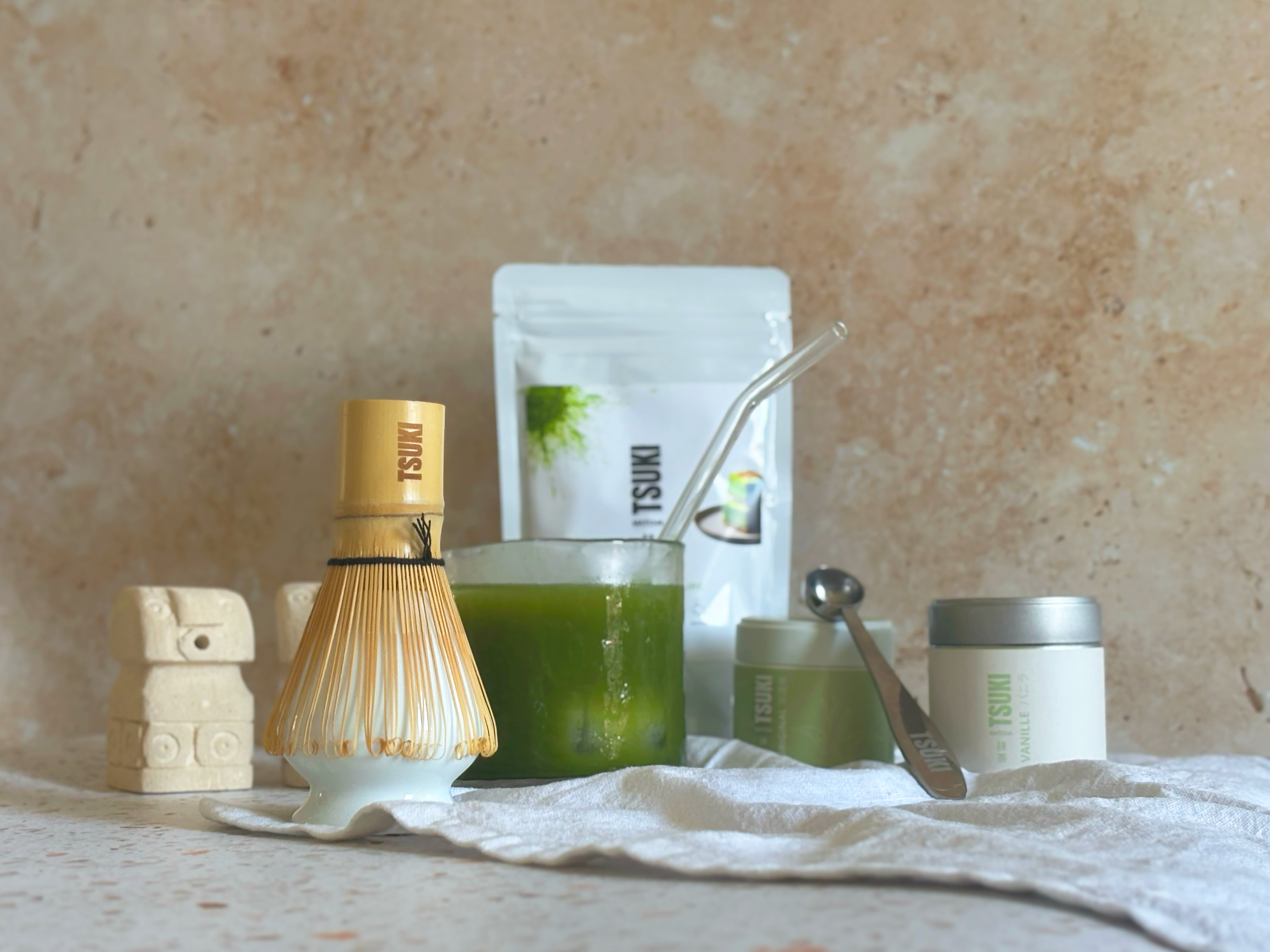
Tout sur le Matcha
Plongez dans l’univers du matcha : bienfaits, origines, recettes et astuces du quotidien.
Le matcha est bien plus qu’une simple boisson. Cette poudre fine de thé vert japonais, issue de feuilles ombragées puis finement moulues sur pierre, incarne à la fois une tradition millénaire et un superaliment moderne aux multiples bienfaits. Consommé depuis des siècles au Japon, notamment dans le cadre de la cérémonie du thé, le matcha séduit aujourd’hui pour son goût unique, sa richesse nutritionnelle et son énergie douce et durable.
Riche en antioxydants, en catéchines et en L-théanine, le matcha japonais est reconnu pour soutenir la concentration, le métabolisme, l’équilibre intérieur et la vitalité au quotidien. Que vous souhaitiez découvrir ses bienfaits, comprendre son origine, apprendre à le préparer correctement ou explorer des recettes créatives, vous trouverez ici toutes les clés pour intégrer le matcha dans votre routine.
Du matcha traditionnel dégusté en usucha aux lattes modernes, des conseils de conservation aux rituels inspirés de la culture japonaise, cette collection vous guide pas à pas pour comprendre, choisir et savourer pleinement le matcha sous toutes ses formes.

Ikigai et rituel matcha : trouver son sens au quotidien à la japonaise

Tea time japonais : l'art de prendre le thé, du sencha au matcha

Hojicha vs matcha : lequel choisir selon vos besoins ?

Thé vert : bienfaits, types et différence avec le matcha

Thé matcha : le guide complet pour débutants et initiés

Macha thé : c'est quoi exactement, et quelle est la différence avec le matcha ?

Matcha : le guide ultime pour tout comprendre en 2026

Astringence et amertume dans le matcha : comprendre le goût pour mieux choisir

Matcha boisson : tout savoir avant de vous lancer

Chlorophylle et matcha : pourquoi la poudre verte est si riche en chlorophylle

L-théanine : l'acide aminé du matcha qui change tout pour le focus

Bienfaits du matcha : ce que dit vraiment la science

Thé vert gunpowder : origine, bienfaits et préparation

Thé chai : origine, épices et recette du chai latte maison

Thé Earl Grey : origine, bienfaits et comment bien le préparer

Thé noir : bienfaits, composition et comparatif avec le matcha

Genmaicha : le thé au riz grillé japonais, bienfaits et recette

Golden latte : recette, bienfaits et pourquoi c'est la boisson anti-stress du moment

Hojicha : qu'est-ce que c'est, bienfaits et comment le préparer

Thé vert, hojicha, matcha, chai : quel thé choisir selon vos envies ?
Affichage de 40/127
Suivant
Le thé matcha
Originaire de Chine, le matcha est devenu une tradition majeure au Japon, notamment à travers la cérémonie du thé. Les moines bouddhistes l’utilisaient déjà pour accompagner leur méditation.
Ses trois particularités
C’est un thé vert en poudre que l’on fouette et non que l’on infuse, il offre des bienfaits puissants car on consomme la feuille entière, et il peut aussi être utilisé comme ingrédient en cuisine, dans des boissons comme des recettes.

Comment préparer le thé matcha ?
Préparer le thé matcha ne consiste pas simplement à mélanger une poudre à de l’eau chaude.
Ce rituel japonais repose sur quelques gestes précis qui révèlent toute la finesse du matcha : une eau à la bonne température, une poudre tamisée et un fouettage énergique pour une mousse légère et onctueuse.
Pour ce faire, nous vous conseillons d’opter pour notre matcha Original ou matcha Vanille.
En quelques minutes seulement, vous transformez votre pause en un véritable moment de calme et de concentration.
Avec un matcha de qualité et les bons accessoires, préparer son matcha à la maison devient un plaisir simple et quotidien.

Un matcha 100% japonais, cultivé avec respect et savoir-faire
Tous nos matchas proviennent du cultivar Yabukita, reconnu pour sa qualité aromatique et sa richesse en umami.
Les feuilles de thé sont récoltées dans les régions de Shizuoka et Kagoshima, réputées pour ses plantations de thé d’exception.
Les bienfaits du thé matcha ❤️
Envie de twister votre matcha autrement qu’en latte ? Découvrez toutes nos recettes faciles, sucrées, salées, à boire ou à déguster — à réaliser chez vous en un clin d’œil !
Des idées recettes pour varier les plaisirs

Matcha banane : nos recettes gourmandes (banana latte et banana bread latte)

Murasaki Matcha : la boisson d'automne la plus belle du moment

Dubai Matcha : Lait de Pistache, Matcha Cérémonial & Crème Kunafa

Matcha coco : recette du latte et du smoothie à la noix de coco

Financiers au matcha : la recette parfaite en 30 minutes

Dirty matcha : la recette espresso + matcha qui change tout

Bubble tea matcha : recette du boba maison en 30 min
