Your supermarket's tea aisle now offers matcha at attractive prices. But between vague origins, unsuitable packaging, and unspecified grades, not all options are created equal.
Here's an honest overview of what you can find at Carrefour, Leclerc, Lidl, Auchan, Intermarché, and Grand Frais, and how to identify a truly quality alternative.
Why matcha is appearing in supermarkets
Matcha has moved out of specialty stores and into the tea aisles of general retailers. Carrefour, Leclerc, Lidl, Auchan, Intermarché, Grand Frais: all now offer at least one option, often with an organic claim and an attractive price.
This democratization is good news for discovering the drink. It also poses a real problem of clarity for consumers. Packaging rarely mentions the region of cultivation, the cultivar, the harvest date, or the grinding method, yet these are the four criteria that determine the quality of a matcha powder.
The result is sometimes excellent for culinary use, but rarely good enough for pure tasting.
Let's look at what's behind the most common options, store by store.
Carrefour Matcha: what can you find on the shelf?
At Carrefour, the house brand is now Carrefour Bio matcha, a 55g glass jar sold for around €4.99. The label states 100% organic green tea matcha, AB certified. It's an honest entry-level product at a low price.
As is often the case in mass retail, the packaging remains discreet about the criteria that determine real quality. It doesn't mention the region of cultivation, the cultivar, or the grinding method. The product is legally still matcha, but without the benchmarks that distinguish a premium Japanese matcha intended for pure tasting.
In addition to this house brand, carrefour.fr also offers many matchas through its marketplace, sold by third-party merchants. The origins vary widely, from Japan to other Asian provenances, and the product description does not always detail the region or the harvest. It's therefore best to check the precise origin before buying.
What to look for on the packaging
Three pieces of information determine the real quality. The production region, ideally Shizuoka, Uji, Nishio, or Kagoshima. The cultivar, with Yabukita being a solid reference. The grinding method, with stone milling remaining the standard for a fine, unoxidized powder.
If these three mentions are absent, you are probably buying ground green tea, not real shaded matcha.
Leclerc Matcha: decent value for money, nothing more
Leclerc offers several options depending on the store, often from general organic brands. Prices range from approximately €15 to €35, with sizes from 50g to 250g for larger packages.
The main advantage is the price, generally 30% to 50% lower than specialized stores. Turnover in hypermarkets also limits the time spent on shelves, which is useful for a product sensitive to oxidation. The disadvantage is the vagueness about the exact origin and intended use (pure drink or cooking), whereas the difference between ceremonial grade and culinary grade makes all the difference in tasting.
Also note: a matcha tea labeled organic and of Japanese origin sold for €8 or €10 for 50g raises questions. In Japan itself, a decent ceremonial matcha rarely starts below €1 to €1.50 per gram. A very low price almost always indicates a late harvest, rapid mechanical grinding, or simply ground classic green tea.
Lidl Matcha: unbeatable price, culinary quality
Lidl matcha, often sold under the Loyd brand, is priced around €4.99 for 40g in an organic Japanese version. This is one of the lowest prices on the market, which explains some of its success.
Tasting feedback from various individuals converges on several points. The color is dull rather than vibrant green, indicating a late harvest, little shading, and a matcha poorer in chlorophyll and L-theanine. Bitterness is low, making it accessible to beginners, but also less expressive on the palate. Crucially, the transparent plastic packaging exposes the powder to light, which accelerates the oxidation of a product that, on the contrary, requires opaque and airtight storage.
Honest conclusion: Lidl matcha is not a bad product for its price range, but it is closer to a culinary matcha usable in lattes, pastries, or smoothies, rather than a ceremonial matcha to be drunk pure.
Auchan Matcha: limited offer, variable origins
At Auchan, the offer remains thinner than at Leclerc or Carrefour. You mainly find general organic brands, with formats from 30g to 100g.
The products often bear the mention "origin Japan" on the front, without specifying the region or the harvest. Some are also of Chinese origin, which is not disqualifying in itself, but radically changes the aromatic profile. Ground Chinese green tea produces a more astringent, less umami powder, poorly suited for pure consumption.
The average price is around €15 to €25 for 100g, which remains reasonable for culinary use, but limits expectations regarding tasting.
Intermarché and Grand Frais Matcha: troubleshooting rather than discovery
Intermarché offers a similar selection to Auchan, with one or two organic options depending on the store, often in 50g format. The origin is rarely specified beyond the word "Japan".
Grand Frais, positioned in fresh produce and gourmet food, occasionally stocks some higher quality brands, sometimes with more complete information on origin. However, the offer remains inconsistent and largely depends on the individual stores.
In both cases, these stores are useful for quick fixes or trying the drink, but they do not replace a dedicated source when you want to progress in tasting.
The 5 criteria to check before buying matcha at the supermarket
If you're buying at a supermarket, here's the checklist to use in the aisle.
Criterion
What to look for
Warning sign
Origin
Japan, with a specified region (Shizuoka, Kagoshima, Uji, Nishio)
"Asia", "China", or simply "Japan" without a region
Cultivar
Yabukita, Okumidori, Samidori, Asahi
Information missing
Grinding
Stone ground (ishiusu)
"Ground", "milled", without further detail
Packaging
Opaque can or resealable aluminum bag
Transparent plastic, non-resealable pouch
Color
Vivid green, almost fluorescent
Olive green, brown, yellowish
Our matcha producers in Shizuoka, Japan
These five criteria alone do not guarantee exceptional matcha, but their absence almost always guarantees average quality. To go further, the complete guide to choosing good matcha details each criterion with concrete examples.
The online alternative: why specialized brands make a difference
Supermarket matcha has a real use: discovering the drink without breaking the bank, or using it in baking. But as soon as you want to drink it pure, as usucha or in a latte, mass distribution shows its limits.
Specialized online brands operate with different specifications. They source directly from identified Japanese producers, work with specific cultivars, and package in containers that protect the powder from light and humidity. The price per gram is higher, between €0.80 and €1.50 for serious ceremonial quality, but the product served in the bowl is incomparable.
Jade green color, umami notes, long finish, smooth froth when whisked: these are the markers that distinguish a quality matcha from a generic powder.
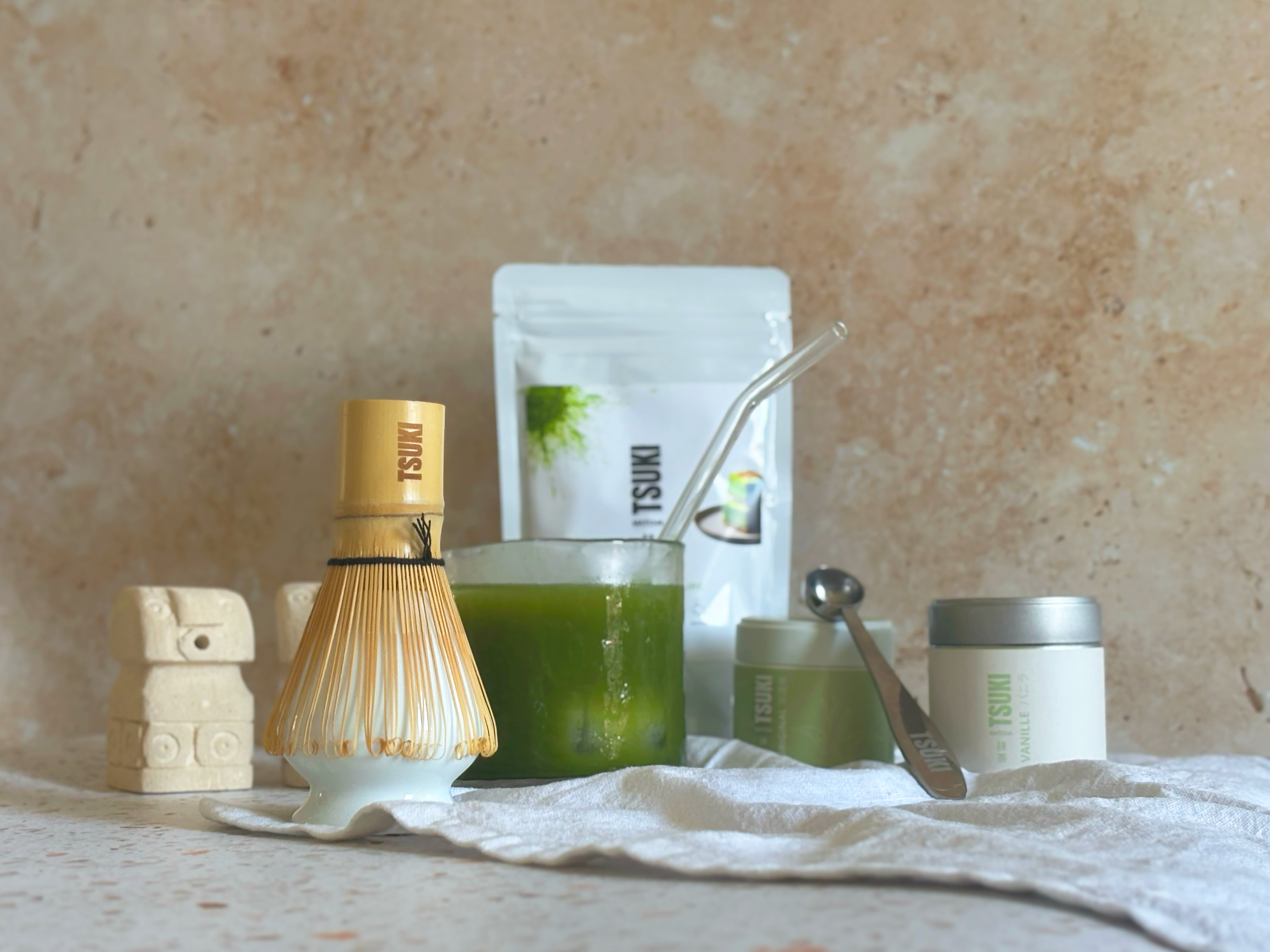
TSUKI Matcha is part of this philosophy. The Original matcha comes from Yabukita leaves from Shizuoka and Kagoshima, shaded for three weeks before harvest according to the tencha process, then slowly stone-ground.
Each box specifies the region, cultivar, harvest, and grinding date. The opaque 30g packaging limits oxidation and corresponds to the optimal quantity for consuming a box in less than two months, before the flavors degrade.
To navigate the current options, our comparison of the best matchas of 2026 reviews the brands available in France, with their strengths and limitations.
How to move from supermarket to true tasting
Many consumers start with supermarket matcha to test it out, then switch to a specialized brand once their curiosity is piqued. This is a logical progression.
If you're in this phase, here are three concrete tips. First, blind-taste two powders prepared in the same way, at the same temperature, with the same dosage. The difference in color and taste is striking. Second, try a complete starter kit with a chasen whisk and measuring spoon, to eliminate preparation errors that often skew judgment. Finally, store the opened powder in the refrigerator, in its original container, to protect its aromas.
Once these three steps are in place, the difference between a hypermarket powder and a serious Japanese matcha becomes evident, and the price jump makes perfect sense. To understand why buying online or in store yields such different results, it all comes down to traceability and stock rotation.
FAQ: supermarket matcha, your frequent questions
Is Lidl matcha truly matcha?
Yes, in the legal sense, it is indeed an organic Japanese green tea powder. In practice, its dull color and very low price indicate a late harvest and probably limited shading, making it closer to a culinary matcha than a ceremonial grade. It can still be used in lattes or pastries without any problem.
Why is Carrefour matcha sometimes Chinese and not Japanese?
The term "matcha" refers to a method (finely ground green tea powder) and not a protected geographical origin. Chinese producers cultivate ground green tea using a process inspired by Japanese tradition. The aromatic profile is different, often more astringent and less umami.
Which matcha should I choose in a supermarket to start with?
Opt for an organic, Japanese product with a mentioned region, in opaque, resealable packaging. A 30 or 50g format is sufficient for testing for about six weeks. Avoid transparent jars and very large formats that oxidize before you can finish them.
Is supermarket matcha suitable for lattes?
Yes, absolutely. For a homemade matcha latte, milk and sugar mask the aromatic flaws of an entry-level matcha. This is where the difference between supermarket and specialist matcha is least noticeable.
Why is quality matcha more expensive?
The price reflects the harvest (first spring harvest = premium), shading (three to four weeks for ceremonial grade), the slow speed of stone grinding (about 40 grams per hour), and stock rotation. Serious Japanese ceremonial matcha rarely starts below €0.80 per gram.
How long can an opened matcha be stored?
Six to eight weeks maximum after opening, ideally in the refrigerator in its original packaging. Beyond that, the aromas oxidize, the color changes, and whisking a good froth becomes more difficult to achieve.
In summary
Carrefour, Leclerc, Lidl, Auchan, Intermarché, and Grand Frais matchas have their place in a discovery journey. They allow you to try the drink at a low price, especially in latte or pastry versions. Their limitations quickly appear when you're looking to taste a true ceremonial matcha: imprecise origin, poor protective packaging, and a subdued color and aromatic profile.
For regular consumption and to appreciate the subtlety of authentic Japanese matcha, a specialized brand remains the most direct path.
Want to taste the difference? Discover our selection of premium Japanese matchas, cultivated in Shizuoka and Kagoshima, shaded using the tencha process, and stone-ground.